Synonyms and antonyms in context: twenty days of nonfiction passages
A short nonfiction passage with five bold words, then 5 questions about what those words mean in the passage, in 10 to 15 minutes a day. Four weeks, one step a week, with a Check Day to close every week. One packet per grade, 3rd through 5th grade, or all three in one bundle.
Passages by grade
Bundle: best value
How the twenty days run
A synonym from a list is easy. Knowing which synonym fits the sentence in front of you is the harder job, and it is the one these packets practice. Every question is about a word as its passage uses it, so the proof is always on the page, and a student can point to the words that prove it.
Four weeks, one step each
- Week 1, Synonyms: find a word that means almost the same in this sentence.
- Week 2, Antonyms: find the opposite of the word as the text uses it.
- Week 3, Shades of Meaning: pick the word closest in strength, or put close words in order from weaker to stronger. In 3rd grade these are words for feelings and how sure someone is.
- Week 4, Context Clues: find the clue nearby, often a synonym or an antonym, that tells what the bold word means.
One day, two pages
- A Learn It page opens each week. You read it together: the week's goal, a three-step strategy, three Words to Know, a short model text and a think-aloud that answers one question and points to its proof.
- The Read page holds the passage and one While I Read task, such as writing a word above each bold word that means almost the same.
- The Respond page has 5 multiple-choice questions, one for each bold word. On Days 1 to 4 it also has a word chart for two of the bold words: the word, what it means in this text, a synonym, an antonym and a sentence of the student's own.
- Day 5 of every week is a Check Day: 5 questions and a short written response in place of the word chart, done without help.
- For you: teacher pages with the skill progression and the standards, and a class record for daily scores and writing scores.
- For students: an anchor page that sets synonyms, antonyms, shades of meaning and context clues side by side, and a progress tracker for each daily score and each week's goal.
- Answer keys with the letter, the answer, the paragraph and the exact words that prove it, plus sample answers for the charts and the writing and a 0 to 2 guide for the writing.
Less help as the week goes on
Day 1 of each week prints one word chart row filled in as a model, with a word from the Learn It page. On Days 2 to 4 the chart rows give only the bold words, and the Check Day has no chart at all. The passages get longer as the weeks go on:
- 3rd grade: about 125 to 149 words in Week 1, 157 to 173 words in Week 4.
- 4th grade: about 170 to 194 words in Week 1, 238 to 242 words in Week 4.
- 5th grade: about 205 to 222 words in Week 1, 248 to 275 words in Week 4.
What each grade covers
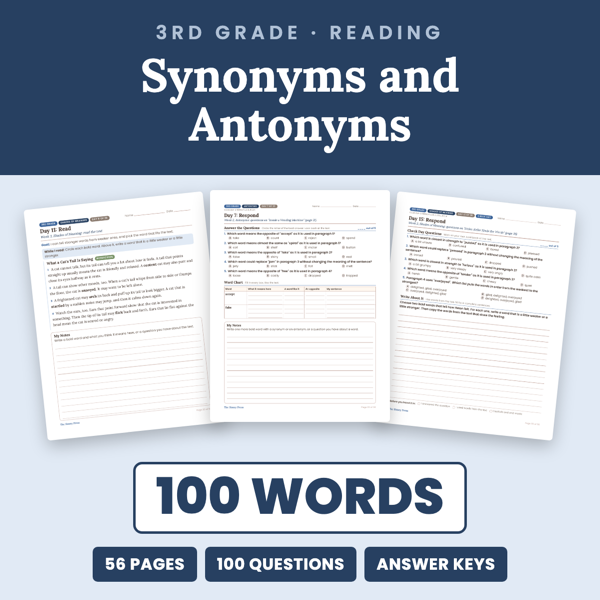
- 3rd grade (56 pages, $7.95): Synonyms, antonyms, shades of meaning and context clues, one a week. Week 3 uses words for feelings and how sure someone is, as L.3.5c asks.
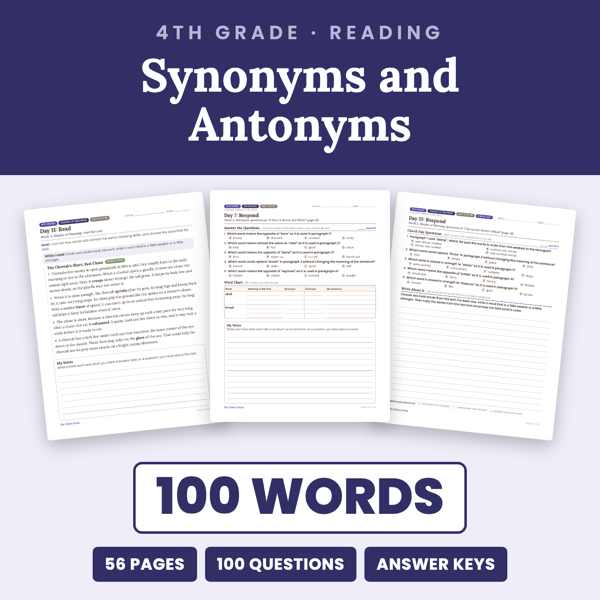
- 4th grade (56 pages, $7.95): Synonyms, antonyms, shades of meaning and context clues, one a week, on passages that grow from about 170 to about 240 words.
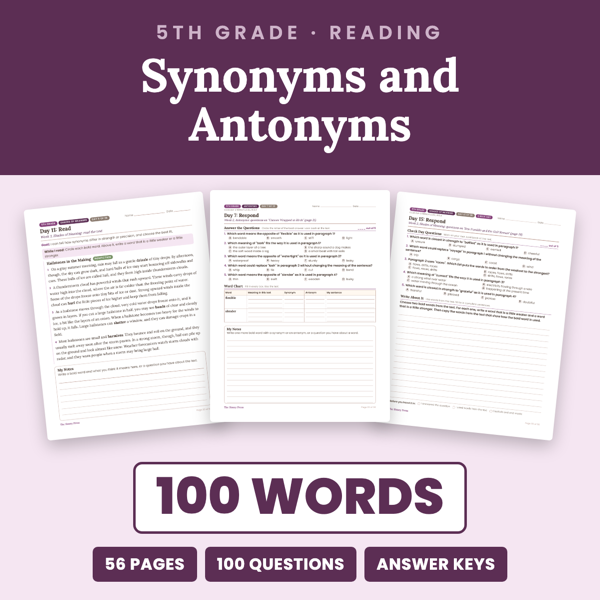
- 5th grade (56 pages, $7.95): The same four weeks, plus 10 homograph questions from Week 2 on (bark, loom, hide, mine, school, pupil, current, story, bank, seal), as L.5.5c asks.
Each packet holds 20 nonfiction passages with 100 bold words, 4 Learn It lessons with model texts, 100 multiple-choice questions, 16 word charts and 4 written responses. Every text was written for its packet.
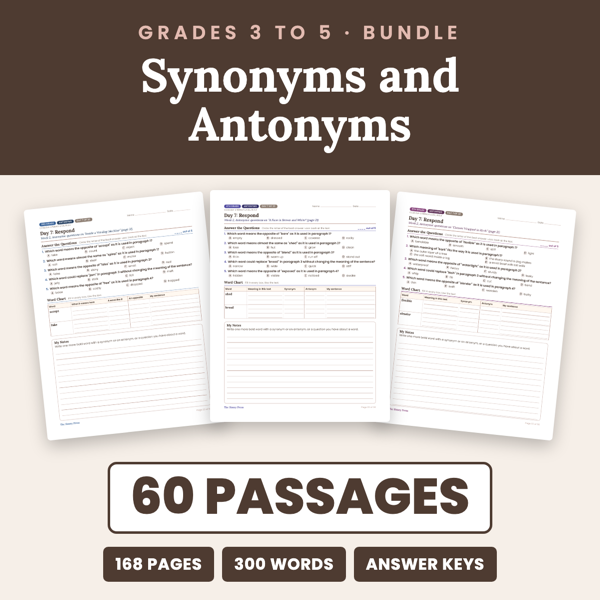
The 3rd through 5th grade bundle carries all three grades, 168 pages, for $16.95, against $23.85 bought separately: 60 nonfiction passages, 300 bold words, 300 multiple-choice questions, 48 word charts, 12 written responses and 12 Learn It lessons. It suits a teacher who loops with a class, or a team that wants one routine for word study across 3rd to 5th.
Where it fits
Whole-class practice, small groups, centers, homework or morning work: the day is short and the same every time, so it runs anywhere you have ten to fifteen minutes.
The main idea passages run on the same two-page day for twenty days, if your class is ready for a second skill. In 4th and 5th grade, so do the character traits passages, the compare and contrast paired passages, the idioms passages and the cause and effect passages. For a small group that needs six weeks across several comprehension skills, the Tier 2 reading intervention packets are the longer option.
Frequently asked questions
How long does a day take?
Ten to fifteen minutes on two pages. The Read page holds a short nonfiction passage with five bold words; students read it and mark the bold words. The Respond page asks five multiple-choice questions, one for each bold word, and on Days 1 to 4 it ends with a word chart.
Can a student answer from a word list?
Every question asks about a bold word as the passage uses it. Many of the bold words have a second meaning, and a wrong answer often fits that other meaning. In a 4th grade passage about meerkats, a "post" is a lookout spot, and "letter" is waiting among the choices. Without the passage, "letter" looks right; the passage rules it out.
What happens on a Check Day?
Day 5 of every week is a Check Day: five questions and a short written response in place of the word chart, done without help. The answer keys have sample answers for the written responses and a 0 to 2 scoring guide for the writing.
What changes in 5th grade?
Fifth grade adds homographs, words spelled the same with unrelated meanings, because L.5.5c names them. Ten days from Week 2 on ask which meaning of a word fits the passage: bark, loom, hide, mine, school, pupil, current, story, bank and seal. Each of those questions has four choices, and the other meaning of the word is one of the wrong ones.
How do I check the answers?
For every multiple-choice question the answer key gives the letter, the answer, the paragraph number and the exact words in the passage that prove it. Word charts and written responses come with sample answers.
Which standards does it cover?
Four in 3rd grade (L.3.5, L.3.5c, L.3.4a and RI.3.4), three in 4th (L.4.5c, L.4.4a and RI.4.4) and three in 5th (L.5.5c, L.5.4a and RI.5.4). The teacher pages show the skill progression with each standard and the questions that practice it.