Math sub plans a substitute can actually run
One scripted week of math review per grade, Kindergarten through 5th, that a stranger can run cold. Each packet has a substitute note, five days plus a spare, a class roster, a no-printer backup, and answer keys that name their page. Print it once and it waits in the folder all year.
Math sub plans, Kindergarten through 5th grade
Bundles: best value
Single grades
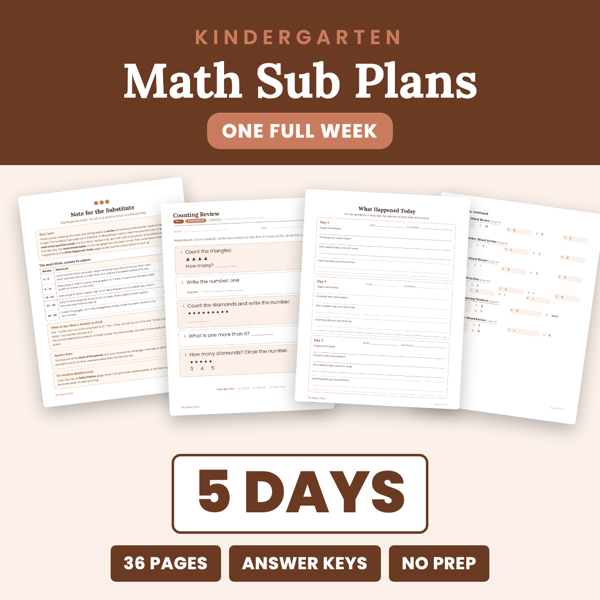 Kindergarten Math Sub Plans $6.95 View on TPT
 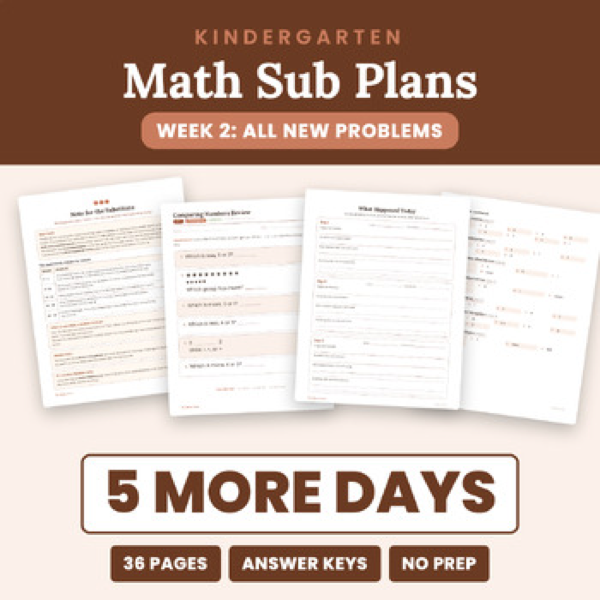 Kindergarten Math Sub Plans Week 2 $6.95 View on TPT
 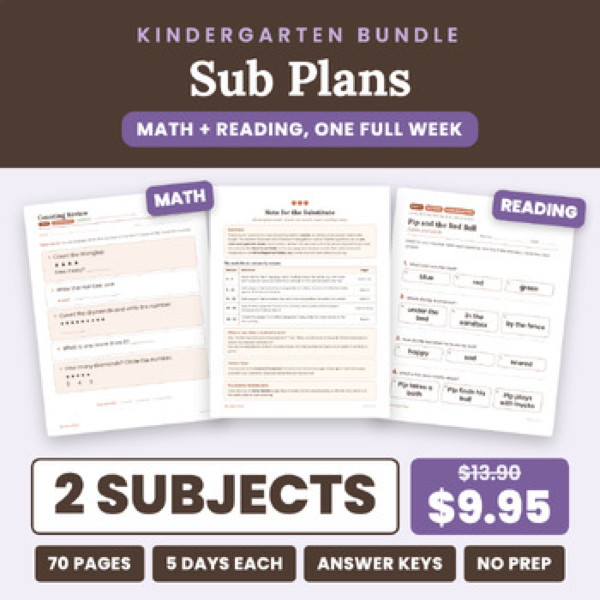 Emergency Sub Plans Kindergarten: 1 Week Math + Reading $9.95 View on TPT
 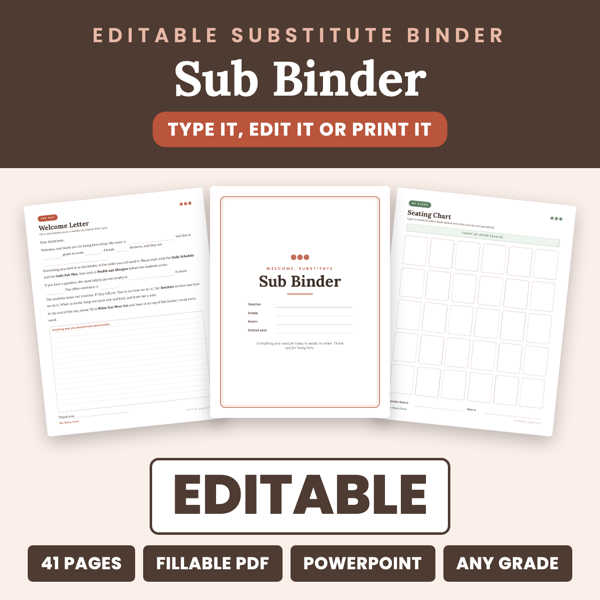 Editable Sub Binder Templates $6.95 View on TPT
 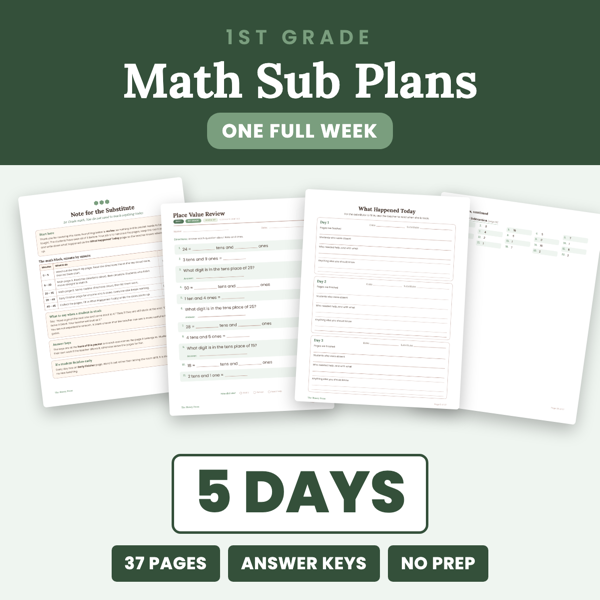 1st Grade Math Sub Plans $6.95 View on TPT
 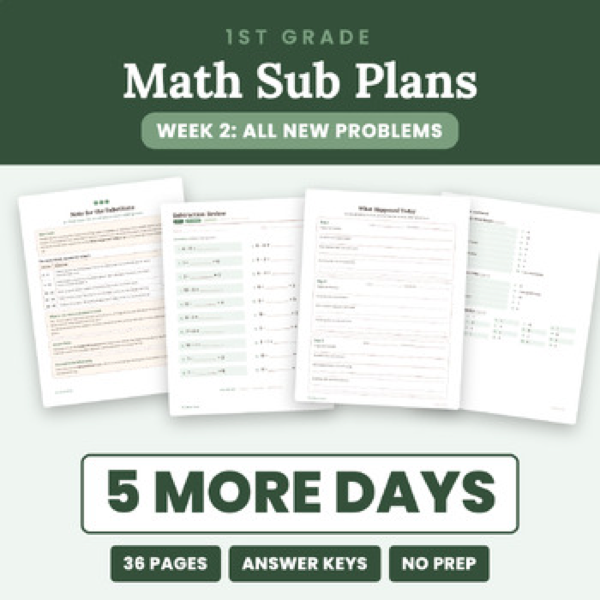 1st Grade Math Sub Plans Week 2 $6.95 View on TPT
 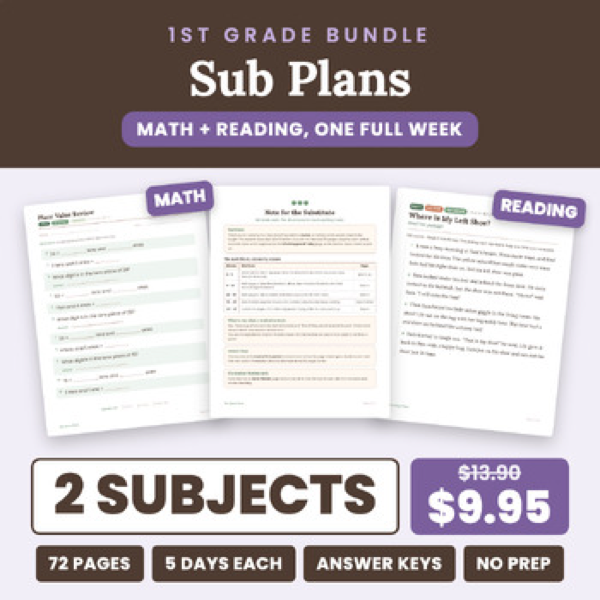 Emergency Sub Plans 1st Grade: 1 Week Math + Reading $9.95 View on TPT
 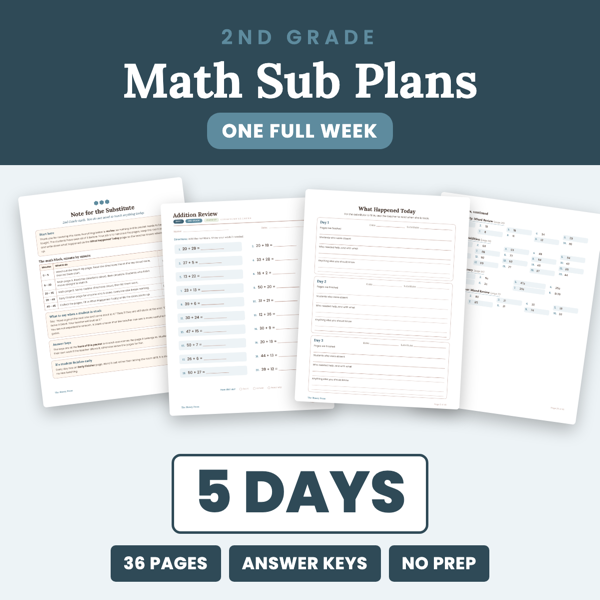 2nd Grade Math Sub Plans $6.95 View on TPT
 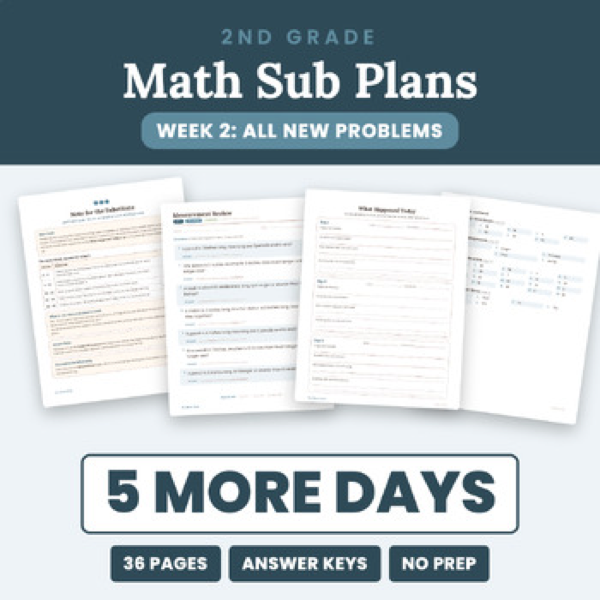 2nd Grade Math Sub Plans Week 2 $6.95 View on TPT
 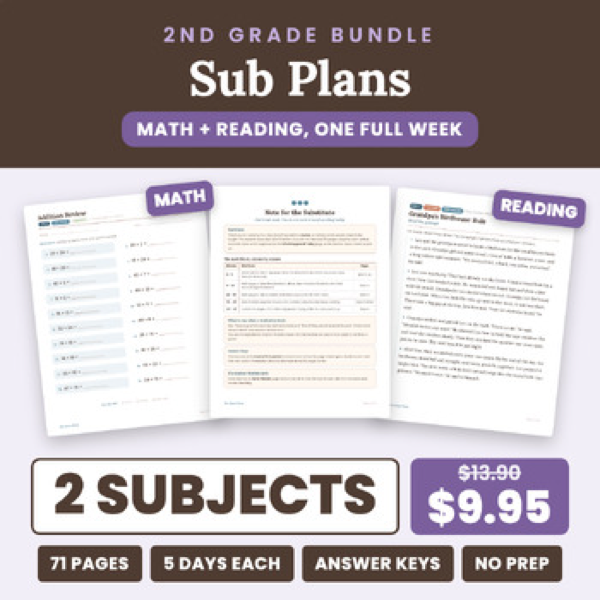 Emergency Sub Plans 2nd Grade: 1 Week Math + Reading $9.95 View on TPT
 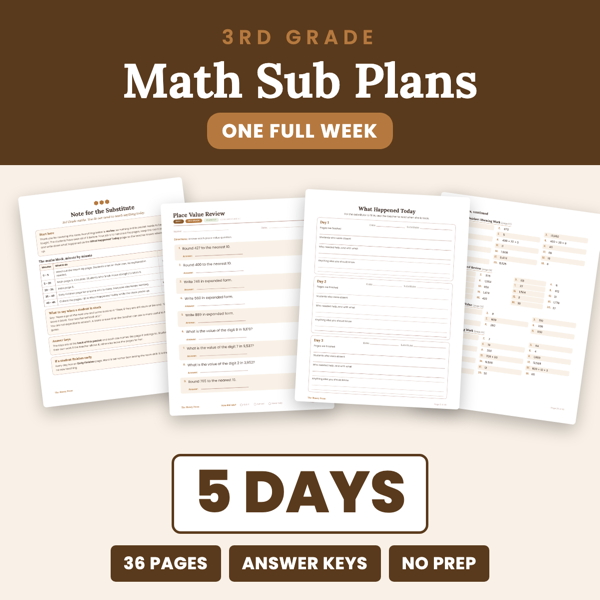 3rd Grade Math Sub Plans $6.95 View on TPT
 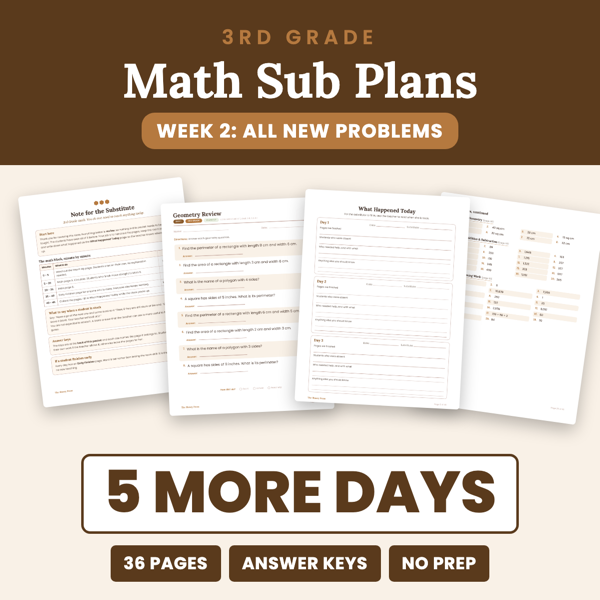 3rd Grade Math Sub Plans Week 2 $6.95 View on TPT
 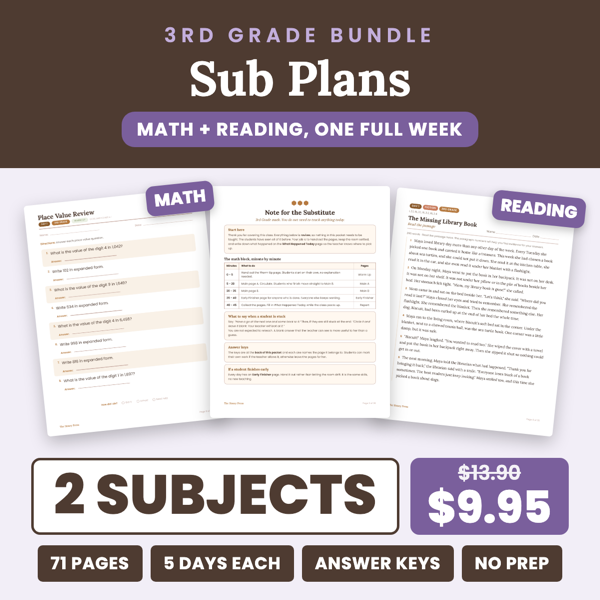 Emergency Sub Plans 3rd Grade: 1 Week Math + Reading $9.95 View on TPT
 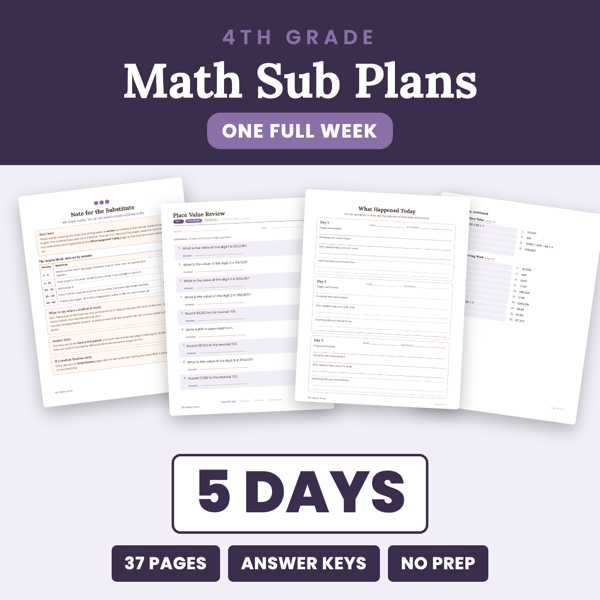 4th Grade Math Sub Plans $6.95 View on TPT
 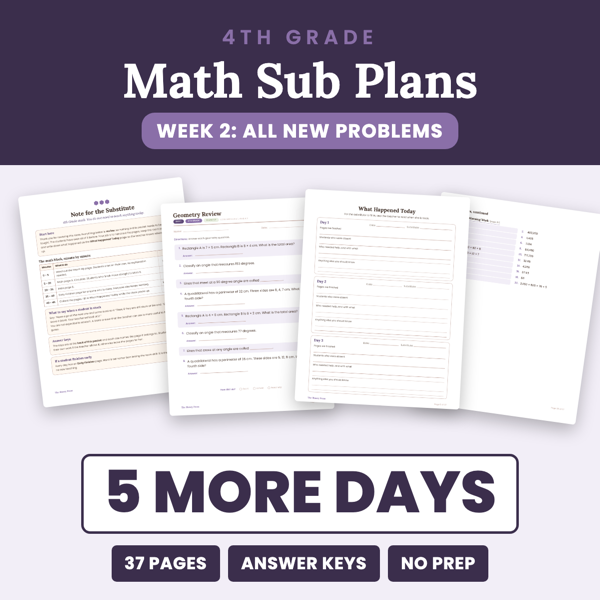 4th Grade Math Sub Plans Week 2 $6.95 View on TPT
 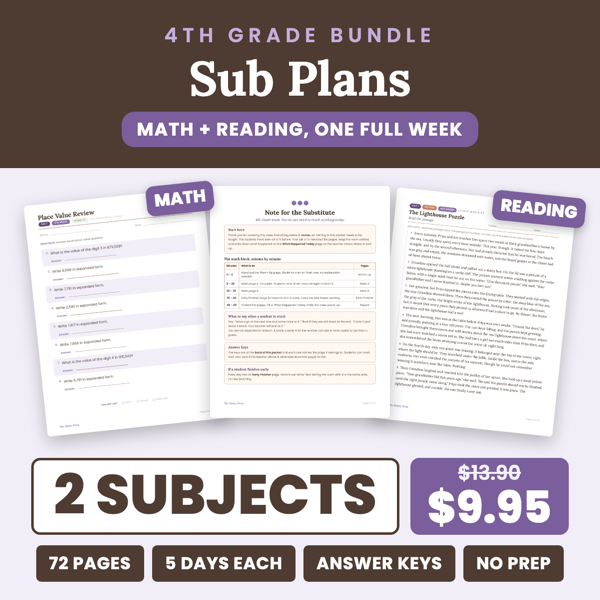 Emergency Sub Plans 4th Grade: 1 Week Math + Reading $9.95 View on TPT
 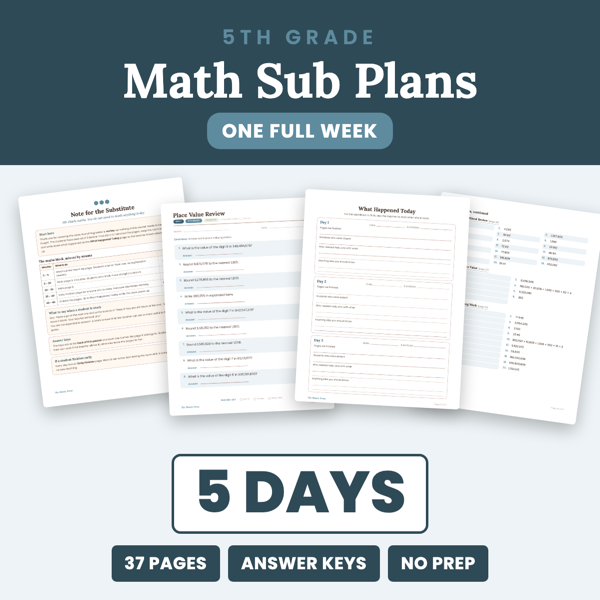 5th Grade Math Sub Plans $6.95 View on TPT
  5th Grade Math Sub Plans Week 2 $6.95 View on TPT
  Emergency Sub Plans 5th Grade: 1 Week Math + Reading $9.95 View on TPT
 See inside before you buy
Real pages from the 4th grade packet, exactly as they print. Every grade shares the same structure: the substitute note first, then the Day 1 pages.
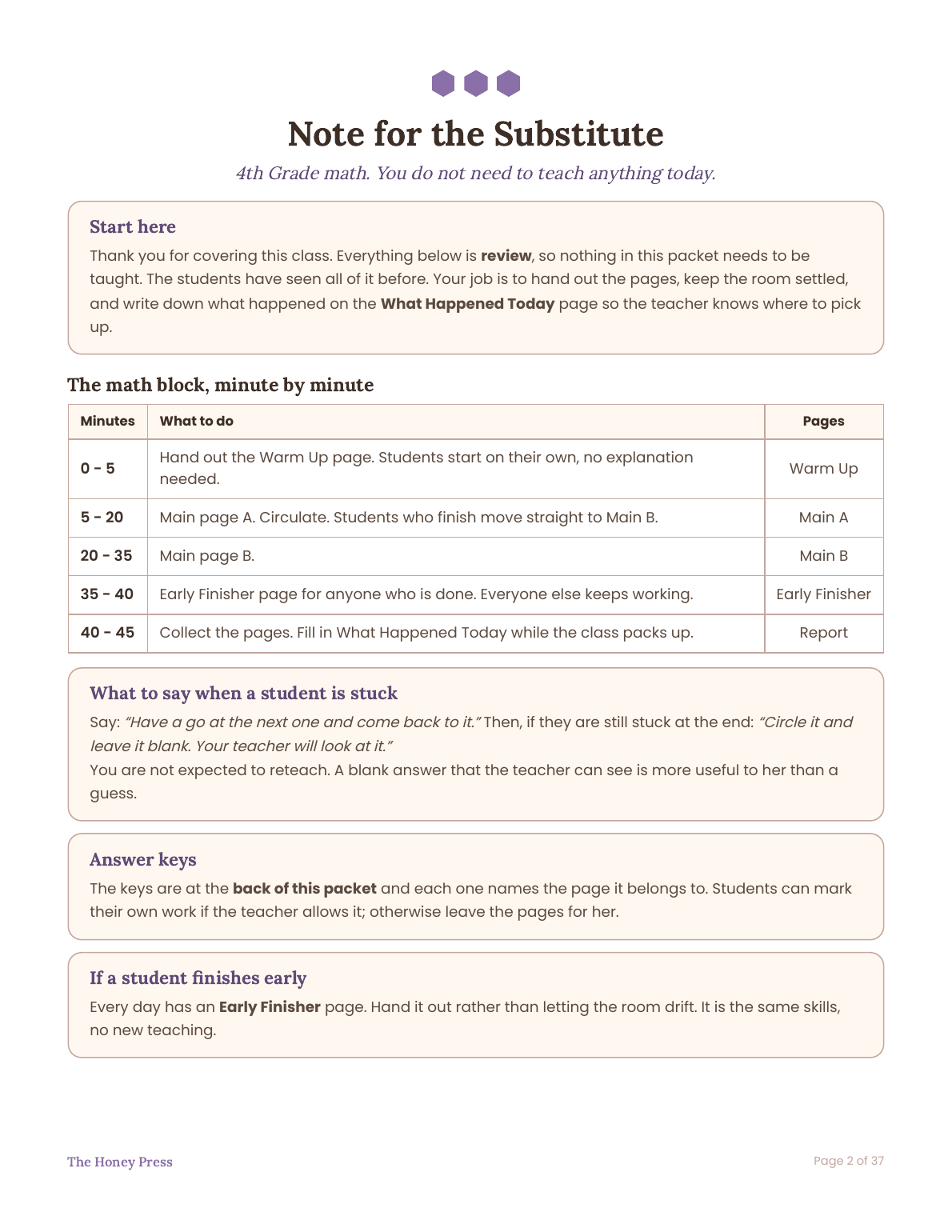
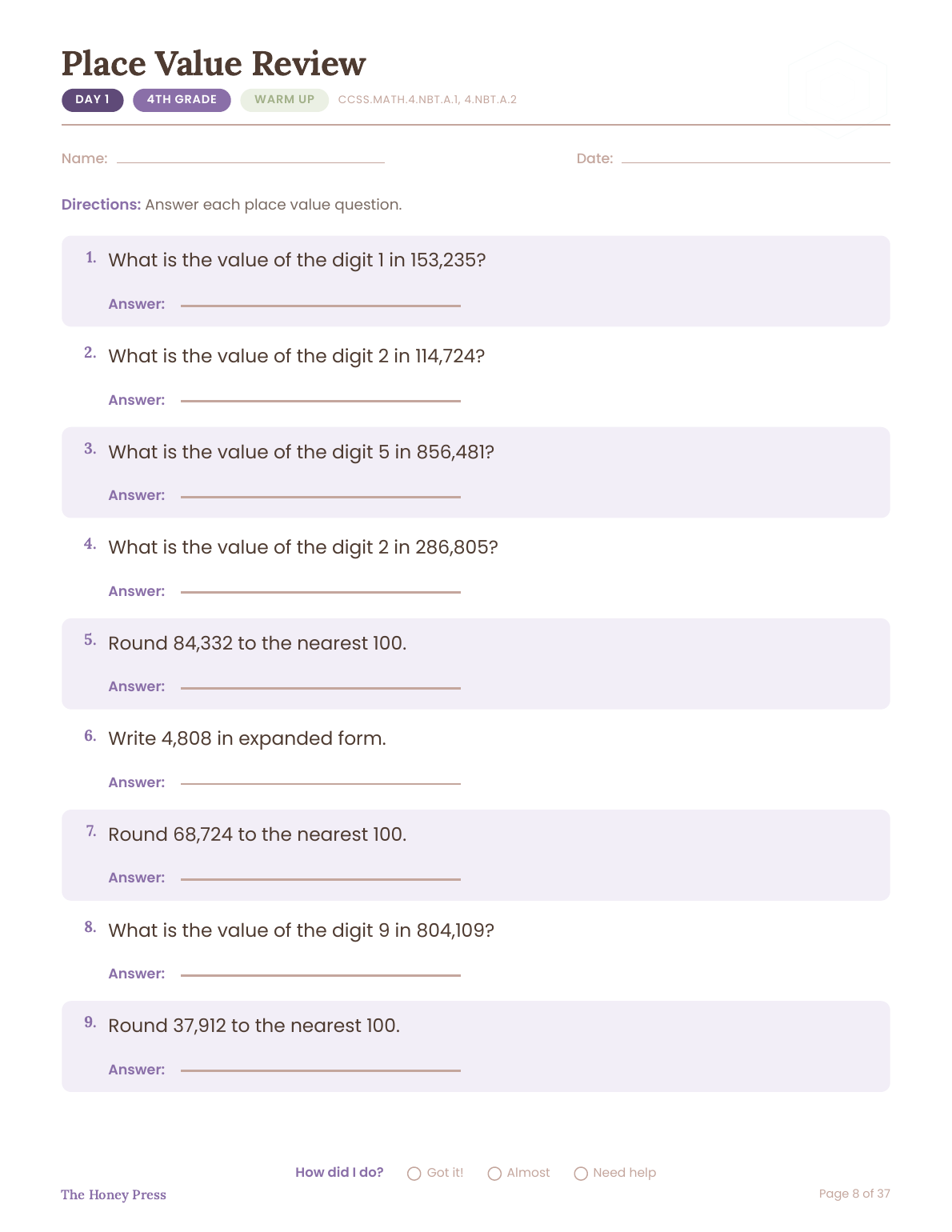
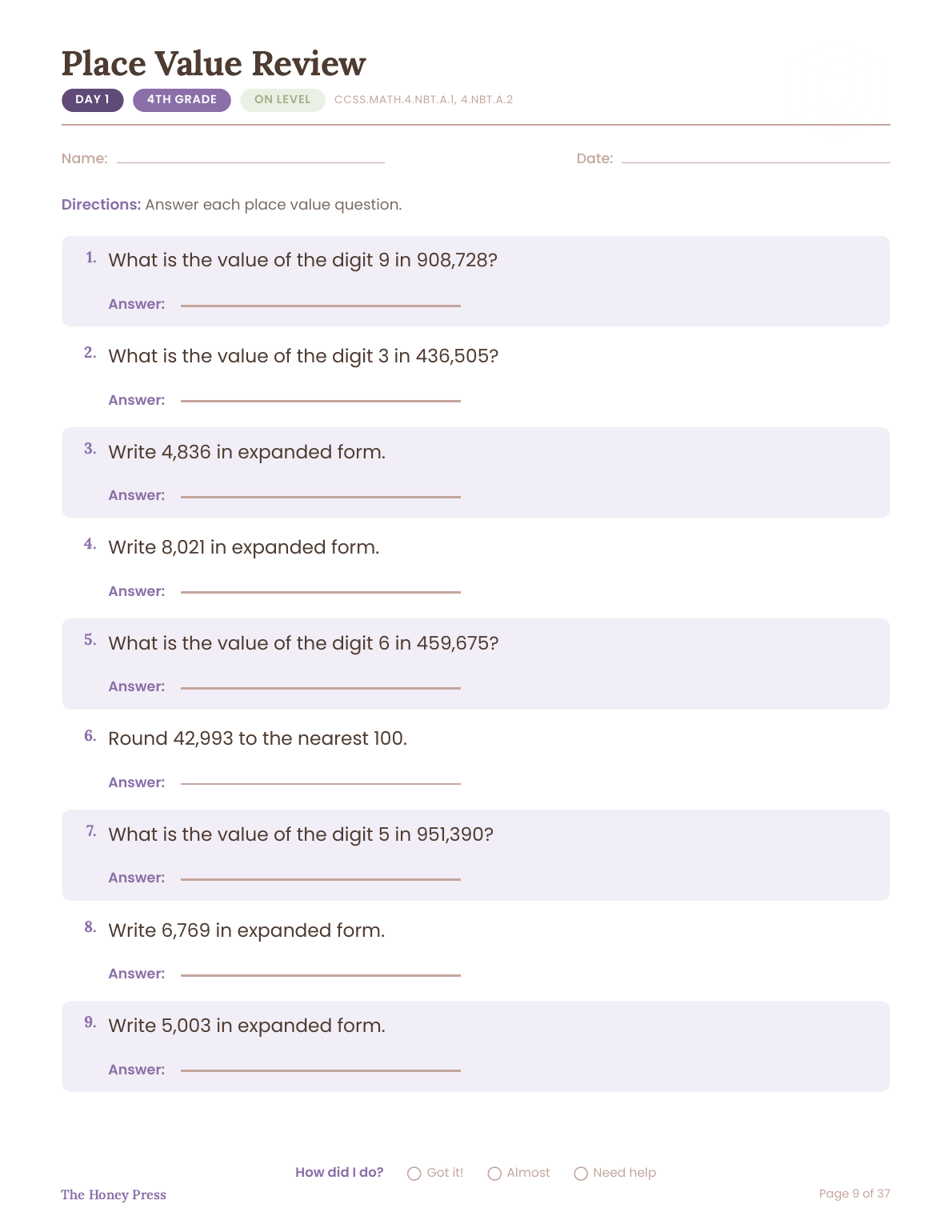
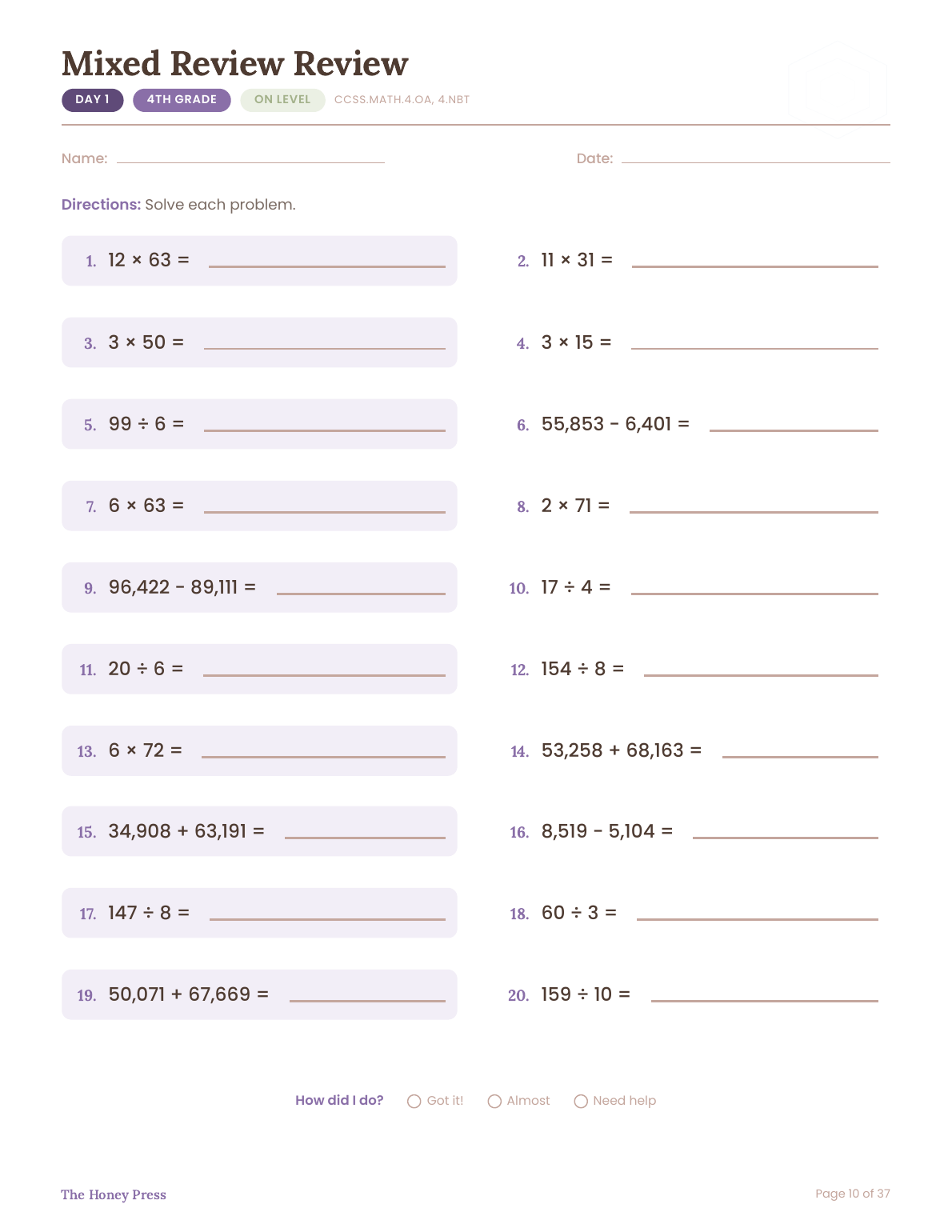
Tap or click the page to flip through. Arrow keys work too.
How a sub week runs without you
Nobody writes good sub plans with a fever. It is 6 a.m., your head is pounding, and you are typing instructions into an email while trying to remember whether the projector remote still works. I have been that teacher, and I built these packets so I never have to be her again.
A good set of math sub plans has one job: it runs without you. Not "runs if the sub is comfortable with fractions." Not "runs if someone can find the manipulatives." Runs cold, on paper, for a stranger who met your class four minutes before the bell.
What makes math sub plans work without you
After enough mornings on both sides of the sub desk, I think it comes down to three rules.
1. Review only, nothing to teach
The day falls apart the moment a substitute has to explain new material. So an emergency day should be built entirely from skills your students have already met. Kids know what to do when they see the page, the sub only keeps the room moving, and nobody is learning long division from a stranger.
2. Undated, so it never expires
Plans tied to "wherever we are in the unit" are stale in two weeks, and then you are rewriting them every month to keep the folder current. Undated review works in October and works in April. Print once, forget until needed.
3. Scripted, minute by minute
"Do some math practice" is not a plan. A substitute needs to know what happens at 9:05, what to hand out, what to say to a stuck student, and what to do with the kid who finishes everything in eleven minutes. Writing that script is most of the work, which is exactly why it should be done once, in advance, by someone without a fever.
What goes in the math sub folder
The packet is the engine, but the folder around it matters too. Mine holds four things, in this order, so the most important page is on top.
The substitute note
One page that walks the math block minute by minute: the warm up, the two main pages, the early finisher, where the answer keys live, and a line about what to say when a student says "I don't get it" (the answer is "skip it and circle it," not an impromptu lesson).
The class roster
A roster with a column for each day, so the sub can mark who was present and who turned in work. When you are out for three days, that grid is how you reconstruct the week.
The student work, sorted by day
Five days, four pages per day, already in order. If you can, paper clip each day separately. A sub sorting loose pages at 8:40 is a sub who is not watching the room.
The answer keys, labeled by page
Keys that name the page they belong to, so checking work takes minutes and students cannot talk the sub out of an answer. Keys also let the sub give real feedback instead of collecting a pile of mystery paper.
The minute-by-minute math morning
Here is the rhythm each day in these packets is scripted around. It is deliberately boring, and boring is what a strange adult in a familiar room needs.
- First 10 minutes: warm up page. Every student can start it without help, which buys the sub time to take attendance and find the pencil sharpener.
- Middle 30 to 40 minutes: the two main pages, one at a time. These are the meat of the day: practice on skills the class has already learned.
- The last stretch: early finishers get the fourth page; the sub circulates with the answer key and checks completed work.
- Two minutes at the end: the sub fills in the What Happened Today report: which pages were finished, who was absent, who needed help, and anything you should know before you walk back in.
That report page is my favorite part of the system. Coming back from a sick day is its own small dread, and one honest page from the sub turns "what happened in here?" into a thirty-second read.
What each grade's week reviews
There is one packet per grade, Kindergarten through 5th, because a kindergartner and a 5th grader out on the same Tuesday need very different paper. Every day is review of that grade's own skills:
- Kindergarten (36 pages): counting and writing numbers to 20, before and after, comparing numbers and groups, adding and taking away within 10, flat and solid shapes, then a mixed review day.
- 1st grade (37 pages): addition and subtraction within 20, tens and ones, number patterns, telling time, word problems, then a mixed review day.
- 2nd grade (36 pages): two-digit addition and subtraction with regrouping, counting coins, measuring lengths, word problems, then a mixed review day.
- 3rd grade (36 pages): place value, addition and subtraction, multiplication, division, fractions, word problems, and morning work each day.
- 4th grade (37 pages): place value, multiplication, division, fractions, word problems, and morning work each day.
- 5th grade (37 pages): place value, multiplication, division, fractions, word problems, and morning work each day.
The Kindergarten packet changes the format where a five-year-old needs it: a 30-minute block instead of 45, big type, a Read Aloud line in place of written directions, and a Read Aloud Guide with the exact words for each kind of page. The 1st and 2nd grade packets keep the same skeleton as the upper grades: a Note for the Substitute up front, four pages a day (Warm Up, two main pages, Early Finisher), a sixth spare day, the If You Cannot Print page, a numbered 30-row roster, the What Happened Today page, and answer keys that name their page.
The rest of a kindergarten sub day, from the read-aloud script to the bathroom and dismissal routines, is in my post on kindergarten sub plans.
The other grades have a post each on what that class can do without you on a sick morning:
- Emergency sub plans for 1st grade
- Emergency sub plans for 2nd grade
- Emergency sub plans for 3rd grade
- Emergency sub plans for 4th grade
Emergency math sub plans by grade
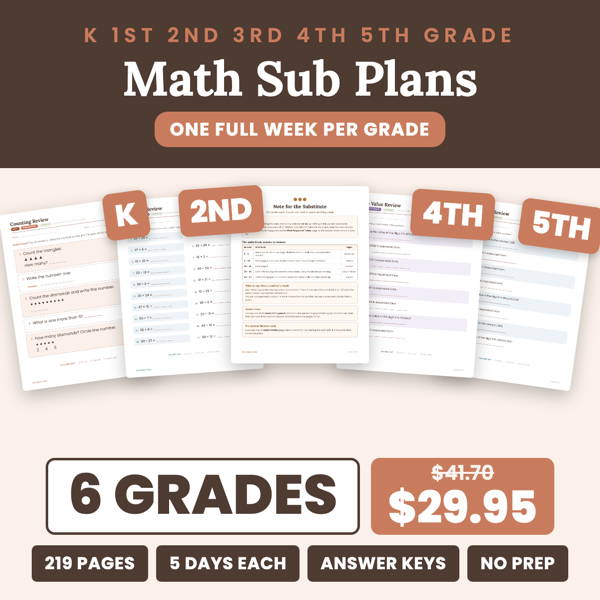
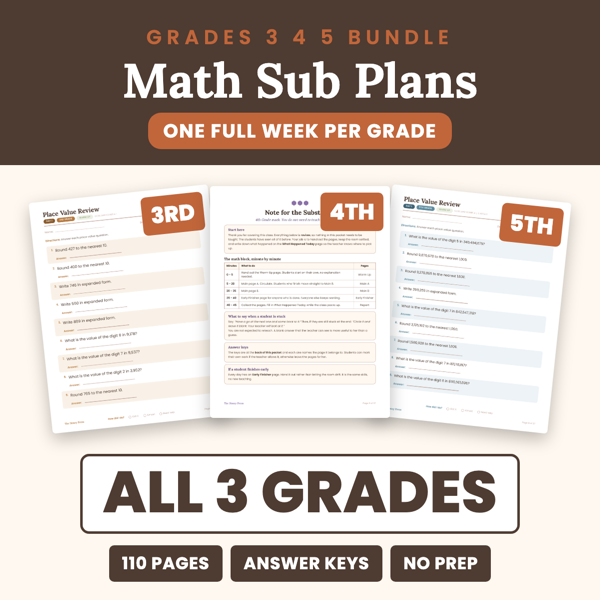
Each grade packet above is one complete week: five scripted days plus a spare, a substitute note, a roster, the no-printer backup, and answer keys for every page. Every grade, Kindergarten to 5th, also has a Week 2, with all new problems, for an absence that runs past five days. The K-5 bundle carries all six grades for $29.95; the grades 1-2 and grades 3-5 bundles are the versions I recommend for teams and anyone who floats between grade levels.
If you want the grade-by-grade detail, including what is on each day and which skills each week reviews, I wrote a full guide for each of the upper-grade packets:
- 3rd grade math sub plans: the full week, day by day
- 4th grade math sub plans: the full week, day by day
- 5th grade math sub plans: the full week, day by day
Out 3 days or a full week? How many days to leave
The usual advice is to keep 3 day emergency sub plans on file, and three days is a sensible floor. It covers the absences nobody schedules: the flu, a sick child at home, a family emergency. Every grade packet above already clears it. Each one is five scripted days plus a spare, so a three-day absence uses half the folder and leaves the rest waiting for next time.
Here is how I match the folder to the absence:
- One to three days: the grade packet on its own. Leave all six days in the folder anyway. The spare days cost a few sheets of paper and cover an absence that runs longer than planned.
- A full week: the same packet, all five days, with the spare day as a cushion. If the sub also has your reading block, add the reading week for your grade, or take the bundle that carries both.
- Two weeks: a Week 2 packet, with the same day structure and all new problems, none repeated from Week 1. There is one for Kindergarten, 1st grade, 2nd grade, 3rd grade, 4th grade and 5th grade.
The grade sub plans bundles below put the whole folder in one file: math, reading, and the Editable Sub Binder for one grade. Every grade, Kindergarten through 5th, carries two weeks of both subjects. The grade pages go through the options for the 3rd grade math and reading sub folder, the 4th grade sub folder and the 5th grade math and reading sub folder.
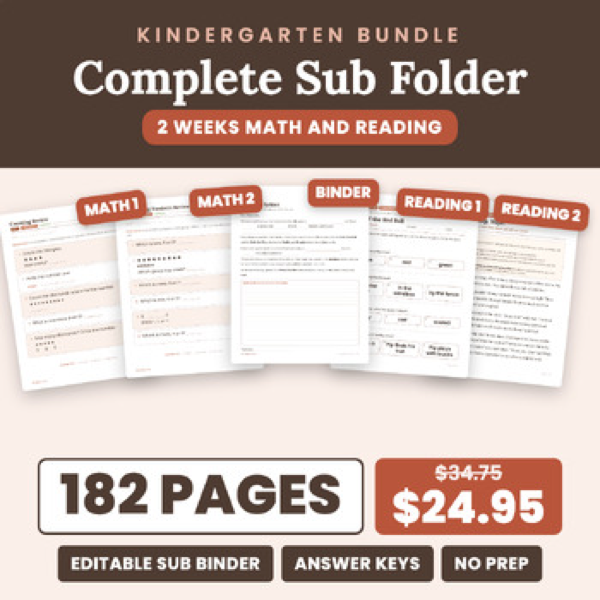 Emergency Sub Plans Kindergarten Two weeks of Kindergarten math, two weeks of reading, and the editable sub binder in one bundle. $24.95 View on TPT
 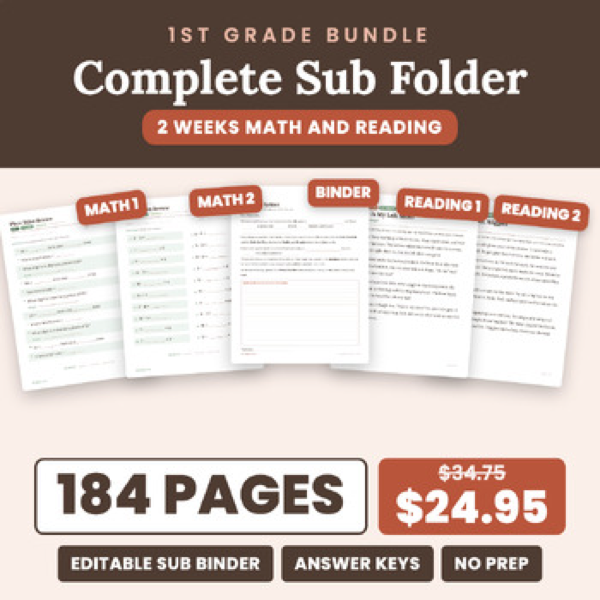 Emergency Sub Plans 1st Grade Two weeks of 1st grade math, two weeks of reading, and the editable sub binder in one bundle. $24.95 View on TPT
 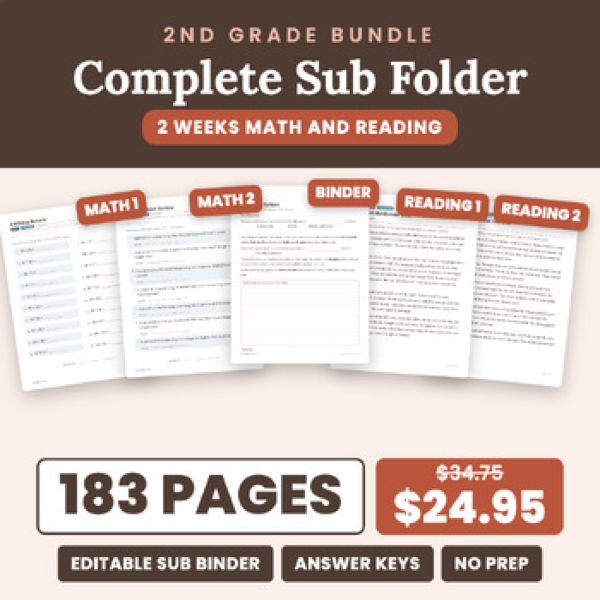 Emergency Sub Plans 2nd Grade Two weeks of 2nd grade math, two weeks of reading, and the editable sub binder in one bundle. $24.95 View on TPT
 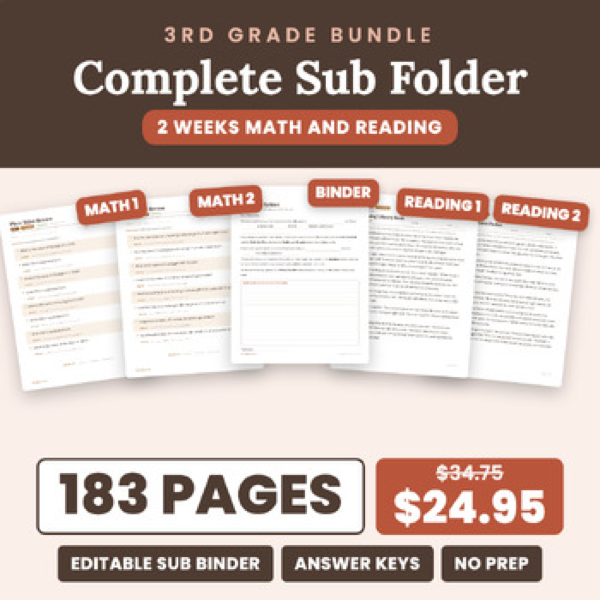 Emergency Sub Plans 3rd Grade Two weeks of 3rd grade math, two weeks of reading, and the editable sub binder in one bundle. $24.95 View on TPT
 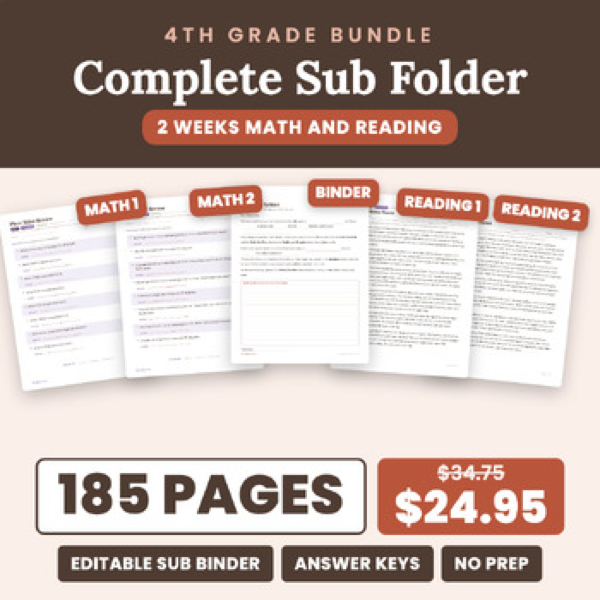 Emergency Sub Plans 4th Grade Two weeks of 4th grade math, two weeks of reading, and the editable sub binder in one bundle. $24.95 View on TPT
 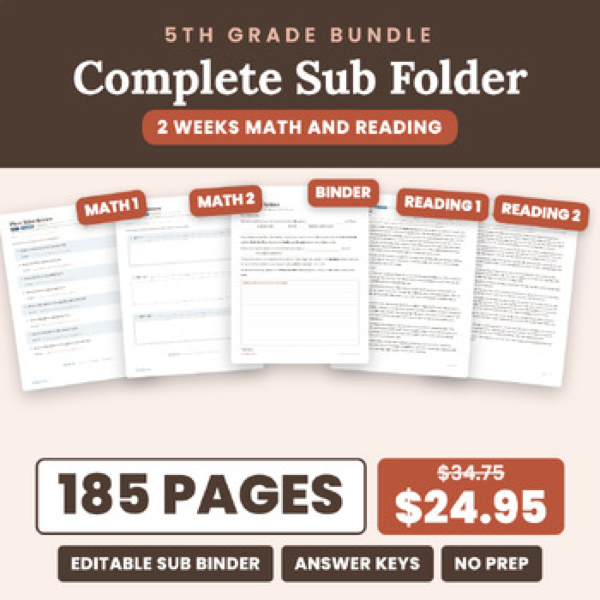 Emergency Sub Plans 5th Grade Two weeks of 5th grade math, two weeks of reading, and the editable sub binder in one bundle. $24.95 View on TPT
 Reading sub plans for the same day
The math block is half of the morning. Every grade from Kindergarten to 5th has a matching week of reading sub plans: an original passage each day with questions, vocabulary and a writing page, and keys that cite the paragraph behind every answer. In Kindergarten the substitute reads the story aloud. Same substitute note, same roster, same What Happened Today page.
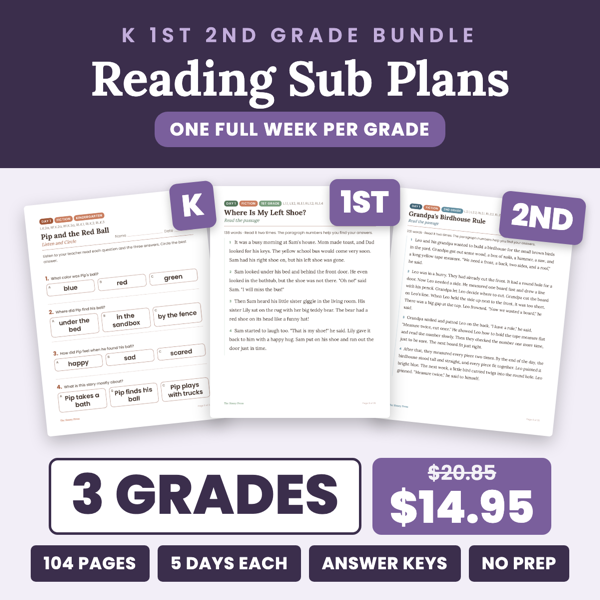 Best value Kindergarten 1st 2nd Grade Reading Sub Plans Bundle $14.95 $20.85 bought separately View on TPT
 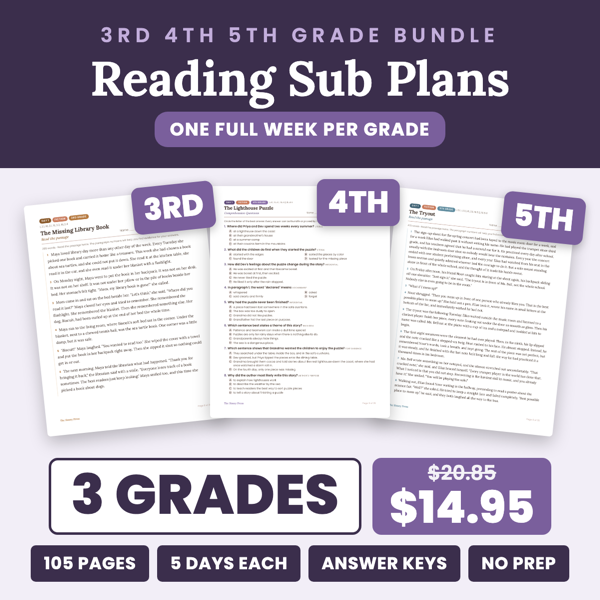 Best value 3rd 4th 5th Grade Reading Sub Plans Bundle $14.95 View on TPT
 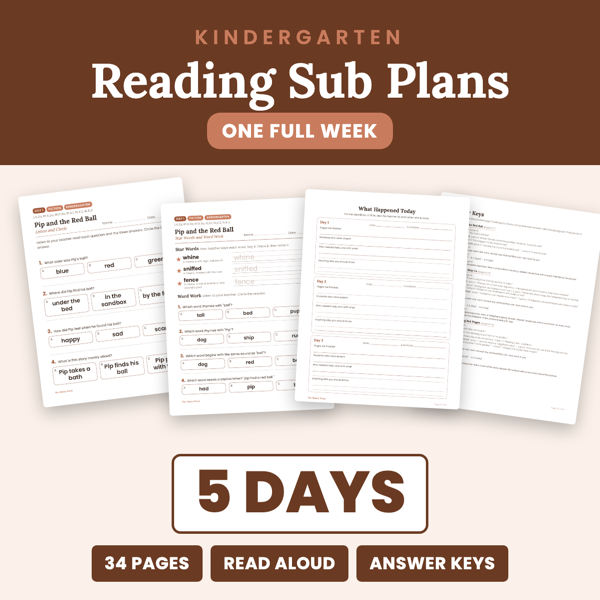 Kindergarten Reading Sub Plans $6.95 View on TPT
 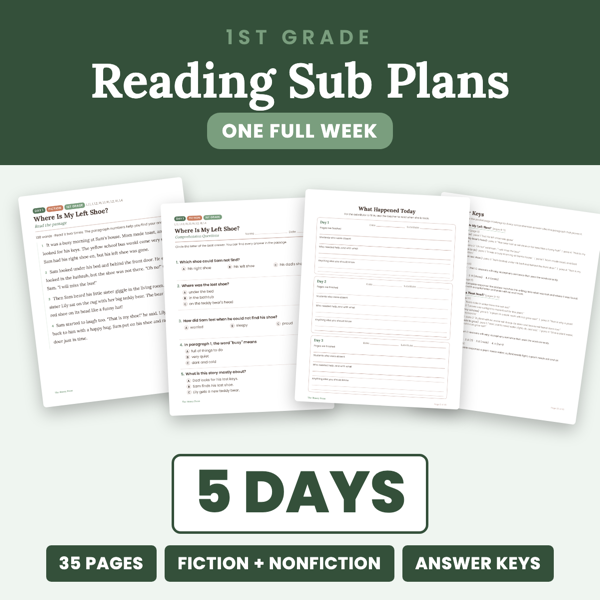 1st Grade Reading Sub Plans $6.95 View on TPT
 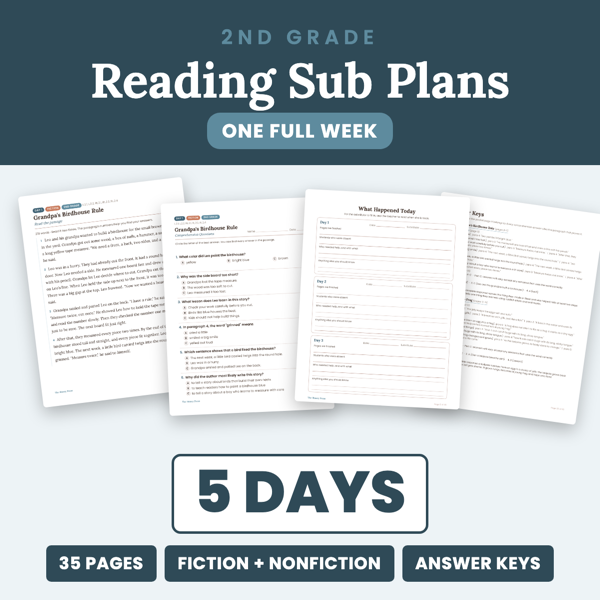 2nd Grade Reading Sub Plans $6.95 View on TPT
 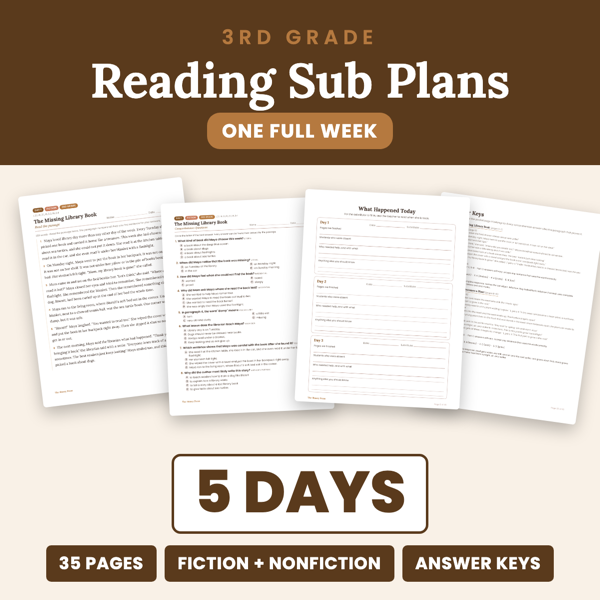 3rd Grade Reading Sub Plans $6.95 View on TPT
 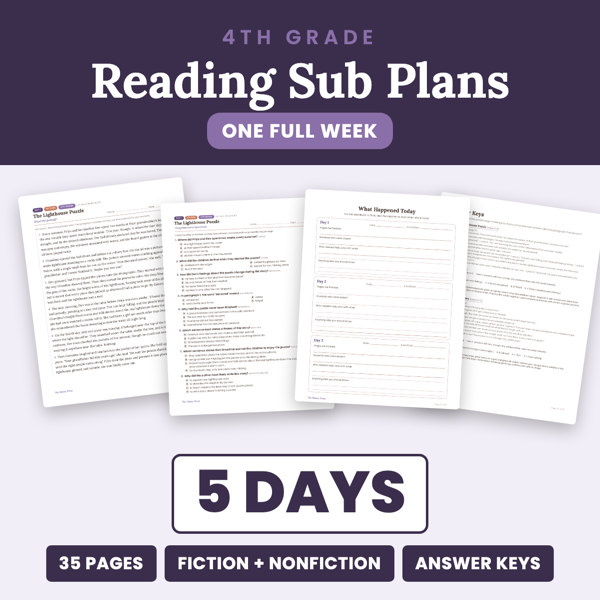 4th Grade Reading Sub Plans $6.95 View on TPT
 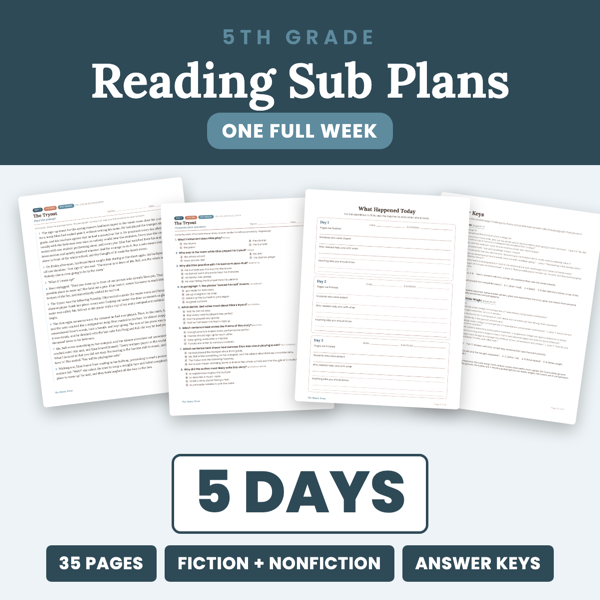 5th Grade Reading Sub Plans $6.95 View on TPT
 Planned absence or 6 a.m. emergency, same folder
For a planned absence, a conference or a field trip for the other half of your team, you can dress these plans up: add the current unit's vocabulary, swap in a page of your own. But the reason to build the folder now is the unplanned morning. When the alarm goes off and your voice is gone, the entire job is one text to the office: "Math is in the red folder on my desk." Then you go back to bed, which is where a person with a fever belongs.
Frequently asked questions
How many days do these math sub plans cover?
Each grade-level packet covers five full days of math, plus a sixth spare day for when one day out turns into two. Every day has four pages: a warm up, two main practice pages, and an early finisher page.
How many days of emergency sub plans should I leave?
At least three, which is the usual advice, and a full week if you can. Each grade packet here is five scripted days plus a spare, so one packet covers both. Every grade, Kindergarten to 5th, also has a Week 2 packet that covers a second week with all new problems, and the grade sub plans bundles add reading and the Editable Sub Binder to the same folder.
Can a substitute who is not a math teacher run these plans?
Yes, that is the design constraint behind every page. Nothing in the packet needs to be taught. Every page is review of skills students have already met, and the substitute note explains the math block minute by minute, including what to say when a student is stuck.
What if the substitute cannot print anything?
Each packet includes an If You Cannot Print page: about twenty minutes of real math the sub can run with nothing but a whiteboard. It is the backup plan for the backup plan.
Do the plans go out of date during the year?
No. The pages are undated review, so the packet works in October and works in April. You print it once, put it in the sub folder, and it waits there until you need it.
Are there math sub plans for Kindergarten?
Yes. The Kindergarten packet is built for children who cannot read directions yet: big type, five to eleven items on a page, and a Read Aloud line at the top of every page, so the substitute reads each question and the class writes. The block is 30 minutes, not 45, and a Read Aloud Guide gives the exact words for each kind of page.
Is there one bundle for every grade?
Yes. The K-5 bundle carries all six packets, Kindergarten through 5th, for $29.95, for a whole building or a team that covers several grades. The grades 1-2 and grades 3-5 bundles are still there for teams that only need those grades.
Are there reading sub plans too?
Yes, for every grade from Kindergarten to 5th: one week of original passages, questions, vocabulary and writing per grade, $6.95 each, or $14.95 for Kindergarten to 2nd together and $14.95 for 3rd to 5th together. In Kindergarten the substitute reads the story aloud.
Are there math sub plans for 1st and 2nd grade?
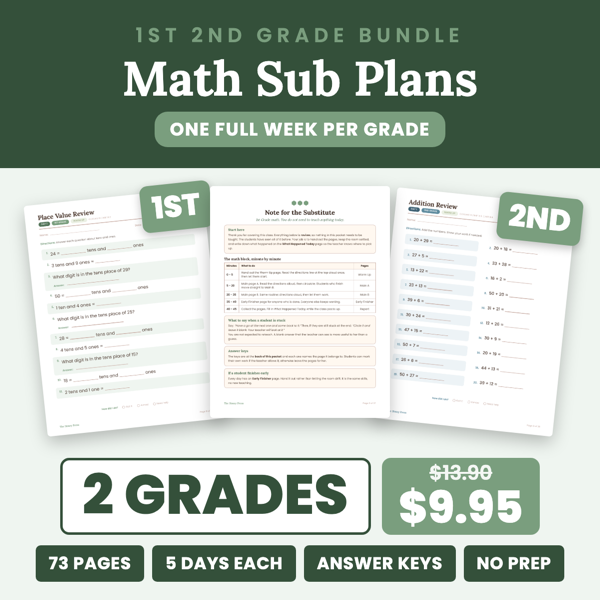
Yes. The 1st and 2nd grade packets follow the same structure as the upper grades: a substitute note, five scripted days plus a spare, a roster, the no-printer backup, and keys that name their page. Every skill is one the class has already met, so the substitute never teaches, and the grades 1-2 bundle carries both packets for $9.95.