Idioms, adages and proverbs in short stories: twenty days of practice
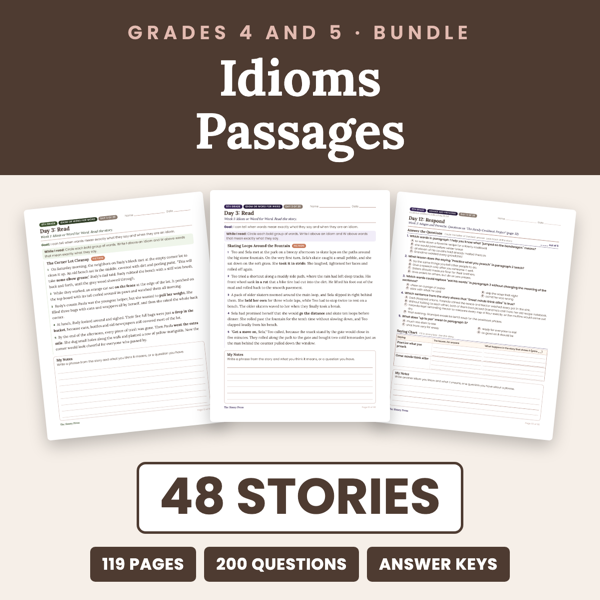
A short realistic fiction story with its idioms and sayings in place, then 5 questions and a chart, in 10 to 15 minutes a day. Four weeks, one step a week, and every week ends on a Check Day, where a short written response takes the place of the chart. One packet per grade, 4th and 5th grade, or both in one bundle.
Stories by grade
How the twenty days run
Word for word, "spill the beans" is pouring beans out of a can; as an idiom it means to tell a secret. The stories never say what an idiom means. Every idiom and saying sits inside a story, and the meaning has to come from the story: what a character does, what happens because of it, or what the other person says or does next.
Four weeks, one step each
- Week 1, Idiom or Word for Word? Decide whether a phrase in bold means exactly what it says or is an idiom, then explain the idiom.
- Week 2, Clues in What People Say and Do: work out what a speaker's idiom means from what the listener says or does next. In 5th grade, clue words such as because, but and while join in.
- Week 3, Adages and Proverbs: put a saying's lesson into words, then find the moment in the story that shows it is true.
- Week 4, Find It on Your Own: nothing is in bold, so students find the idioms and the saying themselves and explain each one with a clue.
One day, two pages
- A Learn It page opens each week. You read it together: the goal, a three-step strategy, three Words to Know, a model story and a Watch Me think-aloud that solves one question and ends with the proof in the story.
- The Read page has the story, its paragraphs numbered, and a While I Read task for the week. In Week 2 it reads: "Circle each bold idiom. Box the name of the person who says it. Underline what the other person says or does next."
- The Respond page has 5 multiple-choice questions and a chart: an Idiom Chart in Weeks 1 and 2, a Saying Chart in Week 3 and an Idiom Hunt Chart in Week 4.
- Day 5 of every week is a Check Day: 5 questions and a short written response in place of the chart, done without help.
- For you: teacher pages with the skill progression, the three standards and how many questions practice each, a class record with a score column for every day and a writing column for every week, and a list of every idiom and saying in the packet with its meaning and the day it appears.
- For students: an anchor page with one idiom set word for word beside its meaning, the kinds of clues (three in 4th grade: action, result and reply; five in 5th, adding cause and contrast), what an adage or proverb is and six phrases to know; a progress tracker; and My Idiom Collection, a page for logging idioms met outside the packet.
- Answer keys with the letter, the answer, the paragraph and the exact words from the story for every question, sample answers for every chart and written response, and a 0 to 2 scoring guide for each Check Day.
One question from each grade
Fourth grade, Day 1, "Waffles on a Snowy Tuesday": question 1 asks how "in hot water" is used in paragraph 1. Choice A reads it as an idiom, Dad is in trouble with Felix. The key gives B, word for word: the syrup bottle sits in a warm bowl, because paragraph 1 says "Dad boiled water in the kettle and poured it into a bowl".
Fifth grade, Day 6, "Tulip Bulbs for the Block": question 3 asks which words in paragraph 3 help you know what "spread myself too thin" means. Zelda says the idiom, and the same sentence goes on to give the reason, after the word because. The key gives A, "she had promised to dig at three houses before lunch", quoted from paragraph 3.
Less help as the week goes on
Weeks 1 to 3 print the phrases to work on in bold. In Week 4 nothing is bold, and the While I Read line gives only a count: "Today there are 4 idioms and 1 saying." on Days 16 to 19, and 5 idioms and 1 saying on Day 20. The first chart of each week has one row filled in from the Learn It story. From the second chart on, every box is the students' to fill: in Weeks 1 to 3 the chart names the phrases, in Week 4 students write in idioms they found, and the Check Day has no chart at all. The stories are longer in Week 4 than in Week 1:
- 4th grade: 193 to 224 words in Week 1, 252 to 258 words in Week 4.
- 5th grade: 225 to 238 words in Week 1, 261 to 285 words in Week 4.
What each grade covers
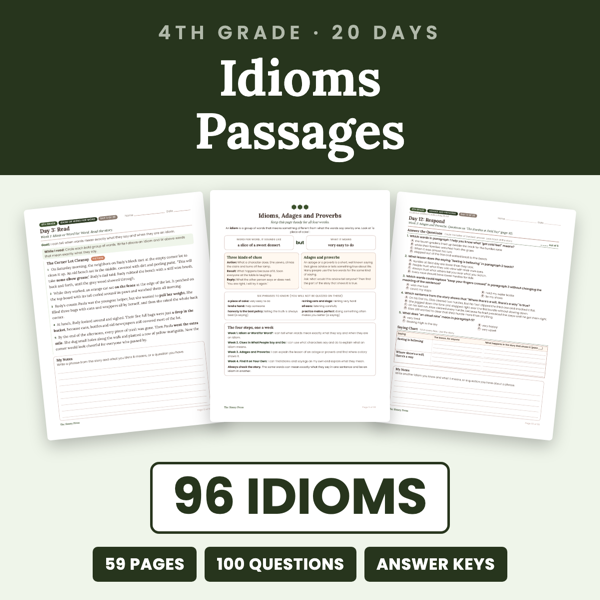
- 4th grade (59 pages, $7.95): Idioms, adages and proverbs, one step a week, in 20 day stories that end with a hunt for phrases printed with nothing in bold: 96 idioms (6 of them used only word for word) and 17 sayings.
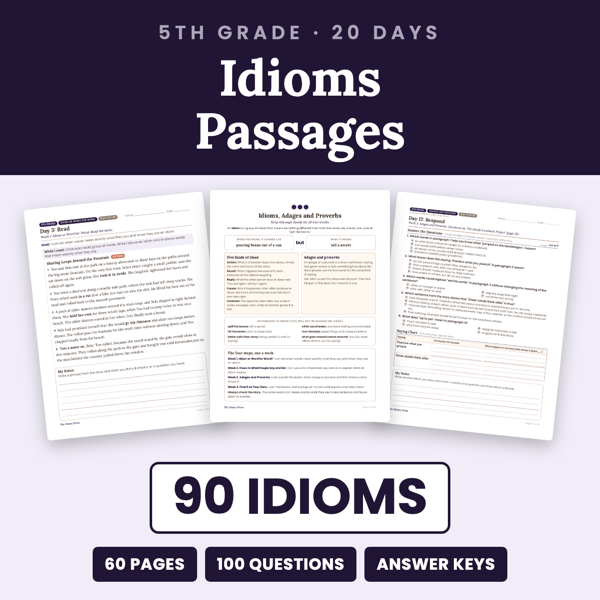
- 5th grade (60 pages, $7.95): The same four steps with 90 idioms, 17 sayings and 6 more phrases used word for word, none of them from the 4th grade packet, and five kinds of context clues, cause and contrast among them, as L.5.4a asks.
Each packet holds 24 original stories (20 for the days and 4 on the Learn It pages), 100 multiple-choice questions, 16 charts (8 Idiom Charts, 4 Saying Charts and 4 Idiom Hunt Charts) and 4 written responses. Both grades list the same mix: 90 phrases used as idioms, 6 used only word for word in their stories, and 17 sayings. The 4th grade packet counts its 96 idioms with those 6 included; the 5th grade packet counts 90 idioms and names its 6 apart. No idiom or saying appears in both grades.
The 4th and 5th grade bundle carries both packets, 119 pages, for $11.95, against $15.90 bought separately: 40 day stories, 200 multiple-choice questions, 8 Learn It lessons and 8 written responses. It suits a teacher who loops with a class, or a team that wants one routine for idioms across both grades.
Where it fits
A day is short and every day follows the same two pages: read and mark the story, then answer the questions and fill in the chart, or on a Check Day write the response instead.
In 4th and 5th grade, the character traits passages run on the same two-page day with short stories, and the compare and contrast paired passages do the same with nonfiction, and so do the cause and effect passages. The main idea passages and the synonyms and antonyms passages start in 3rd grade. For a small group that needs six weeks across several comprehension skills, the Tier 2 reading intervention packets are the longer option.
Frequently asked questions
How long does a day take?
Ten to fifteen minutes on two pages. The Read page holds the story and the week's While I Read task; the Respond page has five multiple-choice questions and a chart, or on a Check Day a short written response.
Does a story ever say what an idiom means?
No. Every meaning has to be worked out from a clue in the story: what a character does, what happens because of it, or what the other person says or does next. In 5th grade the clue can also be a cause, often after because or since, or a contrast, often after but, while or unlike.
What changes in 5th grade?
The four steps stay the same. The phrases are all new, the stories run longer, and the anchor page adds cause and contrast to the three kinds of clues. Week 2 teaches the new clues by name: its Words to Know are context clue, cause and effect, and contrast, and its strategy says to look for because, so, but or while.
How do I check the answers?
The answer keys give the letter, the answer, the paragraph and the exact words from the story for every question. Charts and written responses have sample answers, and each Check Day has a 0 to 2 scoring guide for the writing.
Which standards does it cover?
Three per grade, with the number of questions on each: L.4.5b (60), L.4.4a (20) and RL.4.4 (20) in 4th grade; L.5.5b (60), L.5.4a (20) and RL.5.4 (20) in 5th. The teacher pages show where each one is practiced.