Cause and effect in short nonfiction: twenty days, four steps
A short nonfiction text about history, science or how things work, then 5 questions and a cause and effect chart, in 10 to 15 minutes a day. Four weeks, one step a week, and each week closes with a Check Day: a short written explanation instead of the chart. One packet per grade, 4th and 5th grade, or both in one bundle.
Passages by grade
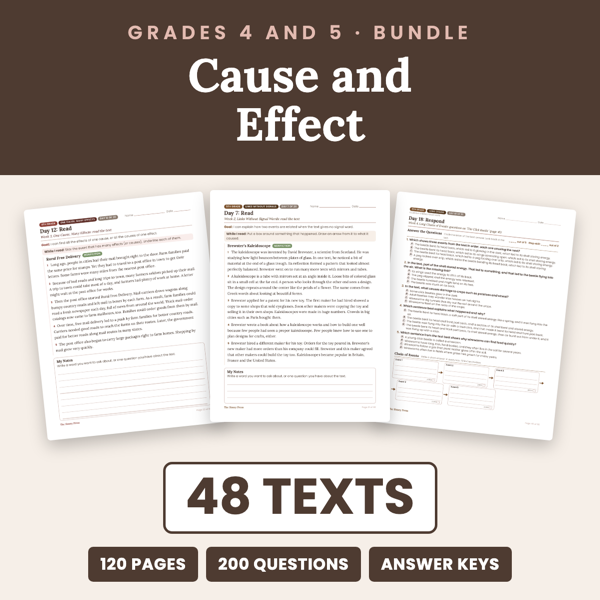
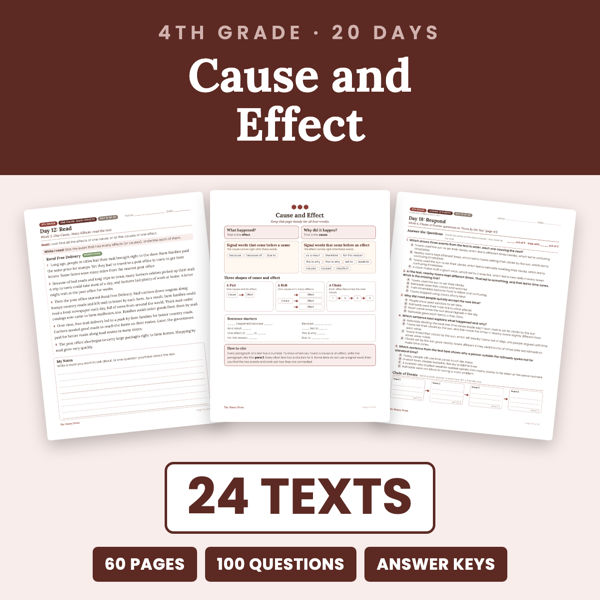
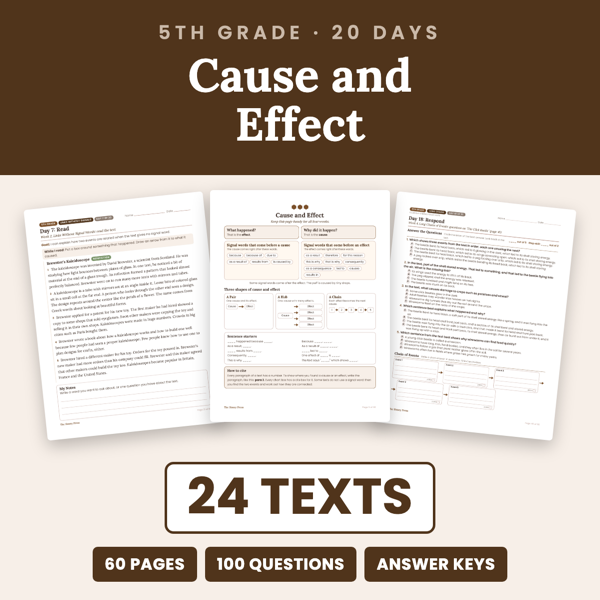
How the twenty days run
When a text says because, the cause and the effect sit on either side of the word. It is harder when the text never says why in so many words, when one cause has several effects, or when each effect sets off the next. Each packet works through those one at a time, a week each, and the answer key ties every answer to a numbered paragraph. The 5th grade packet adds signal words such as "results from" and "is caused by", where the effect comes first and the cause comes after the signal.
Four weeks, one step each
- Week 1, Signal Words (in 5th grade, Signal Words in Either Order): circle the word that joins a cause and an effect, find what sits on each side of it, and say what a paragraph does. In 5th grade the effect can come first.
- Week 2, Links Without Signal Words: explain, in new words, a link the text never marks with a signal word.
- Week 3, One Cause, Many Effects (in 5th grade, Many Causes, Many Effects): find the effects of one cause, or the causes of one effect. The hub chart has three boxes around the center event in 4th grade and four in 5th.
- Week 4, Chains of Events (in 5th grade, Long Chains of Events): put a chain of events in order, where each effect becomes the next cause, and tell what happened and why. A chain has four events in 4th grade and five in 5th.
One day, two pages
- A Learn It page opens each week. You read it together: the goal, a three-step strategy, three Words to Know, a short model text and a Watch Me think-aloud that ends with the proof in the text.
- The Read page holds one text with numbered paragraphs and a While I Read task done in pencil on the text. In Week 4 the 4th grade page reads: "Write 1, 2, 3 and 4 above the events of the chain, in the order each one causes the next." The 5th grade page asks for 1, 2, 3, 4 and 5.
- The Respond page has 5 multiple-choice questions and the week's chart, with a cite box for the paragraph of each cause and effect: a Cause, Signal, Effect Chart in Week 1, Cause and Effect Pairs in Week 2, a Cause and Effect Hub in Week 3 and a Chain of Events in Week 4. Questions 1 and 2 each day are the week's step skill.
- Days 5, 10, 15 and 20 are Check Days: 5 questions and a short written explanation in place of the chart, done alone. In 5th grade every Check Day prompt asks students to use the text's exact words.
- For you: teacher pages with the skill progression, the standards and how many questions practice each, and a class record with columns for each day's score, each Check Day's writing and each week's step-skill total out of 10.
- For students: an anchor page that names what happened as the effect and why it happened as the cause, sorts signal words by whether a cause or an effect comes right after them, draws a pair, a hub and a chain, and gives sentence starters and a way to cite a paragraph, plus a progress tracker. The 5th grade anchor page adds "as a result of", "results from" and "is caused by" to the words that come before a cause, with one example of a signal after the effect: "The puff is caused by tiny drops."
- Answer keys with the letter, the answer, the paragraph and the exact words for every question, sample answers for every chart and written explanation, and a 0 to 2 scoring guide for each Check Day.
- Two blank pages for a text you choose: a Cause and Effect Pairs chart and a Chain of Events chart, both with cite boxes.
The bar is the same every week: Got it means 8 of 10 step-skill questions right and a 2 on the Check Day writing, and the student tracker prints that line too.
One question from each grade
Fourth grade, Day 6, "Starlight on a Long Trip": "How are these two ideas from paragraph 4 connected?" Nothing in the text joins the two with a signal word. The key gives C, planets usually shine with a steady light because a planet looks like a tiny disk, and quotes both ideas from paragraph 4: "a planet looks like a tiny disk, not a single point" and "Planets usually shine with a steady light that does not flicker".
Fifth grade, Day 3, "The Science of a Hiccup": question 1 asks which word or words in paragraph 4 come right before a cause. The sentence that holds the answer names the effect first: "The hic sound results from this sudden closing of the vocal cords". The key gives D, results from. Choice A, "As a result", is in the same paragraph, but an effect follows it, not a cause.
Less help as the week goes on
Days 1, 6, 11 and 16 start the chart with one row or box filled in from that week's Learn It page. The other chart days start blank, Check Days have no chart, and Day 20 asks for one paragraph written alone, with no frame. Page 3 of each packet gives the length of a day's text, week by week:
- 4th grade: about 190 to 203 words in Week 1, 203 to 235 in Week 2, 210 to 248 in Week 3 and 221 to 245 in Week 4.
- 5th grade: about 227 to 260 words in Week 1, 235 to 269 in Week 2, 243 to 278 in Week 3 and 252 to 289 in Week 4.
What each grade covers
- 4th grade (60 pages, $7.95): Signal words, links the text does not state, one cause with many effects, then chains of events, one step a week, across 20 short nonfiction texts on history, science and how things work.
- 5th grade (60 pages, $7.95): The same four weeks and charts, with signal words that can follow the effect, hubs of four, chains of five events and a quotation on every Check Day, across 20 longer nonfiction texts.
Each packet holds 24 original nonfiction texts (20 for the days and 4 on the Learn It pages), 100 multiple-choice questions, 16 cause and effect charts and 4 written explanations. In 4th grade, Day 1 is "A Fast Way to Cook", on the microwave oven, and Day 20 is "Up and Away", on how a rocket lifts off. In 5th grade, Day 1 is "Breezes From the Sea", on why a cool wind blows in from the water on a sunny day, and Day 20 is "The Slime Mold Slug", on tiny cells that clump into a slug that crawls as one. No day text appears in both grades.
The 4th and 5th grade bundle carries both packets, 120 pages, for $11.95, against $15.90 bought separately: 40 day texts, 200 multiple-choice questions, 8 Learn It lessons and 8 written explanations. It fits a teacher who loops with the same class, or a grade team that wants one cause and effect routine from 4th grade into 5th.
Where it fits
Every day follows the same two pages in the same order: read and mark the text, then answer the questions and fill in the chart, or on a Check Day write the explanation instead.
In 4th and 5th grade, the compare and contrast paired passages, the character traits passages and the idioms passages run on the same two-page day. So do the main idea passages and the synonyms and antonyms passages, which also cover 3rd grade. For a small group that needs six weeks across several comprehension skills, cause and effect among them, the Tier 2 reading intervention packets are the longer option.
Frequently asked questions
How long does a day take?
Ten to fifteen minutes on two pages. The Read page holds the text and a While I Read task; the Respond page has five multiple-choice questions and a chart, or on a Check Day a short written explanation.
What kind of texts are they?
Short original nonfiction on history, science and how things work. Every paragraph is numbered, five to a text in 4th grade and five or six in 5th, so every answer can point to one.
What if the text has no signal word?
That is the job of Week 2, the same step in both grades. Students box something that happened, draw an arrow to what it caused, and say how the two are linked in their own words. When no signal word joins two events, the key quotes both of them.
What changes in 5th grade?
The four-week sequence, the charts and the two-page day stay the same, though three of the week names change. In Week 1 the effect can come before the signal word, the Week 3 hubs have four boxes instead of three, the Week 4 chains have five events instead of four, and every Check Day asks for the text's exact words. Each week's word range also sits higher than the same week's range in 4th grade.
How do I check the answers?
The answer keys give the letter, the answer, the paragraph and the exact words for every question. Charts and written explanations have sample answers, and each Check Day has a 0 to 2 scoring guide.
Which standards does it cover?
Three in 4th grade and two in 5th, with the number of questions on each: RI.4.3 (55), RI.4.5 (20) and RI.4.1 (25) in 4th grade; RI.5.3 (75) and RI.5.1 (25) in 5th. RI.5.5 is about structure across two or more texts and each day here has one text, so the 5th grade packet counts its signal word and paragraph role questions under RI.5.3. The teacher pages show where each standard is practiced.