Multi-digit addition and subtraction, one skill a day for 20 days
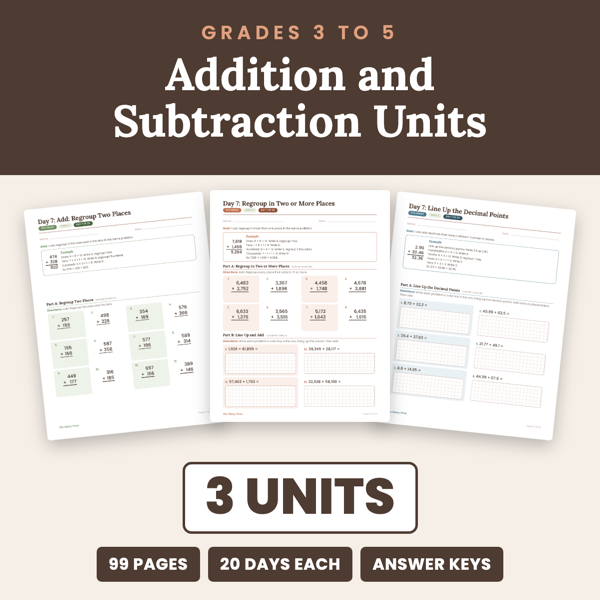
Twenty days of addition and subtraction, one skill a day, with a goal and a worked example on every page. A Pre-Check and a Post-Check show growth side by side. One unit per grade, 3rd through 5th grade.
Units by grade
Bundle: best value
How the units work
Most students can add two numbers that line up neatly. The trouble starts with the problem that needs a regroup, then the one with a zero in the top number, then the one with a decimal point in a different place. Each of those is a separate step, and each deserves its own day.
These units take the steps in order, one a day, for twenty school days. There is one unit per grade, 3rd through 5th grade, and all of them share one design, so a teacher who covers more than one grade runs the same routine in each room.
How a unit is built
- Pre-Check first. It shows who already has the skills before Day 1.
- Days 1 to 20. Each day has a goal, a worked example with every step written out, and practice on that one skill.
- Post-Check last. The same shape as the Pre-Check with new numbers, so the change is easy to see.
- Tracker and toolkit. Students record pre and post scores and check in each day; the toolkit page keeps three worked examples handy.
- Answer keys numbered to match every page.
What each grade's unit covers
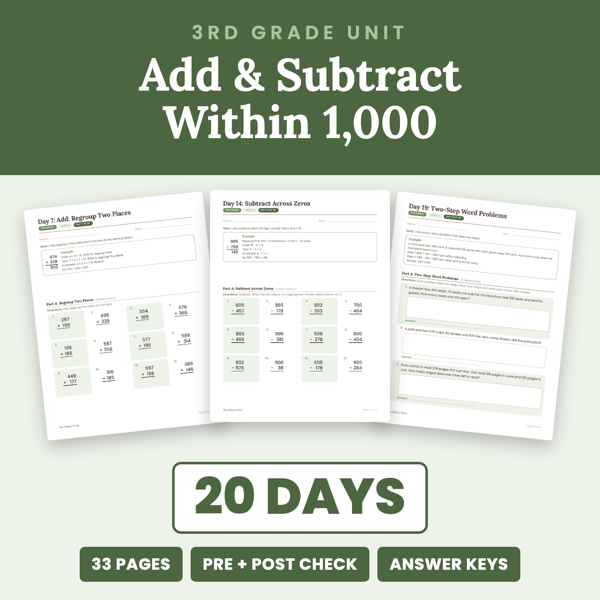
- 3rd Grade Addition and Subtraction Within 1000 Unit (33 pages, $6.95): Twenty days of addition and subtraction within 1,000: place value, rounding, regrouping, subtracting across zeros, two-step problems.
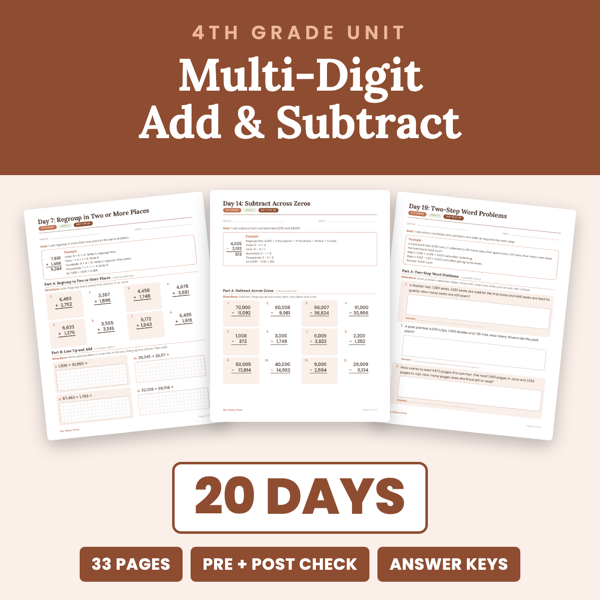
- 4th Grade Multi-Digit Addition and Subtraction Unit (33 pages, $6.95): Twenty days on the standard algorithm: place value to 1,000,000, rounding, regrouping in several places, subtracting across zeros.
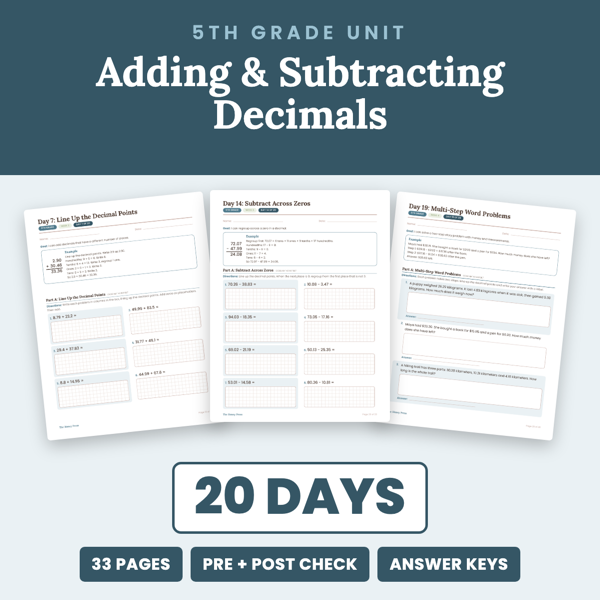
- 5th Grade Adding and Subtracting Decimals Unit (33 pages, $6.95): Twenty days of adding and subtracting decimals: place value to thousandths, lining up the decimal point, money and measurement problems.
The 3rd through 5th grade bundle carries all three units for $14.95, against $20.85 bought separately. It suits a resource room, an interventionist, or a team that wants the same routine across grades.
4th grade math regrouping worksheets
Most of what turns up for 4th grade math regrouping worksheets is a single page of mixed problems. That works as a quick check. It does not teach regrouping, because in 4th grade the problems stop needing one regroup and start needing three in a row, and a student who is shaky on the first one loses the other two.
The 4th grade unit (33 pages, $6.95) takes twenty days on the standard algorithm: place value to 1,000,000, rounding, regrouping in several places, and subtracting across zeros. Each day has a goal and a worked example with every step written out, so the regroup is shown before it is practiced. For a 4th grader who is not yet regrouping reliably within 1,000, the 3rd grade unit covers the same regrouping and subtracting across zeros with smaller numbers. For 3 digit addition and subtraction worksheets, the 3rd grade unit is the one: it works within 1,000, with regrouping and subtracting across zeros.
Addition and subtraction with zeros worksheets
Zeros are where subtraction breaks down. In 4,003 minus 1,587 the ones column needs a regroup, the tens have nothing to give, and neither do the hundreds, so the regroup has to come all the way from the thousands. A student who has only regrouped from the column next door has no move for that problem. In addition the zero usually turns up in the answer instead: 1,346 plus 2,654 regroups in the ones, tens and hundreds and comes out to 4,000.
Subtracting across zeros is part of both the 3rd grade unit, within 1,000, and the 4th grade unit, with larger numbers. In 5th grade the zeros come back as placeholders: 5 minus 2.37 is easier to see as 5.00 minus 2.37, which is where the 5th grade unit's work on lining up the decimal point comes in.
3rd grade rounding and multiplication units
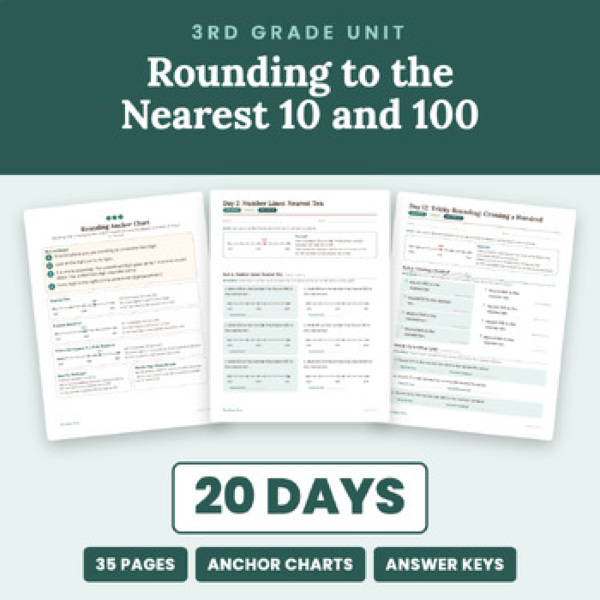
Third grade has two more skills that deserve four weeks each, and they follow addition and subtraction in most fall plans. The 3rd grade rounding unit (35 pages, $6.95) spends twenty days on rounding to the nearest 10 and 100: number lines, the rounding rule, halfway numbers, crossing a hundred, then estimating sums, differences and word problems, with a rounding anchor chart and a rounding chart.
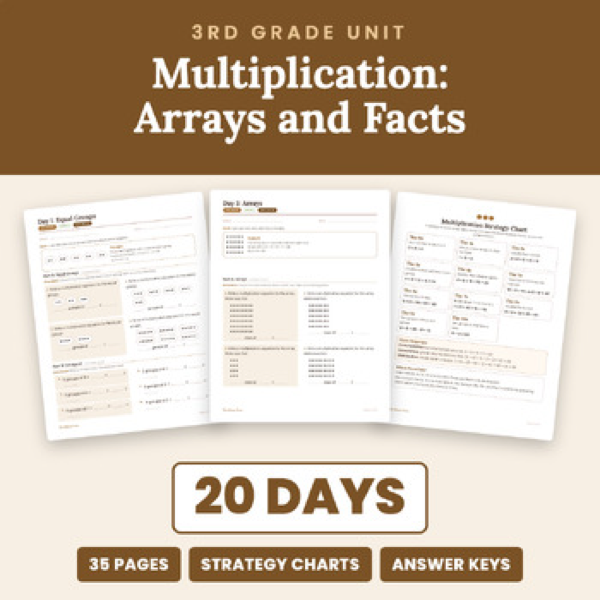
The 3rd grade multiplication unit (35 pages, $6.95) starts from what multiplication means before any fact is memorized: equal groups, arrays, the facts by strategy, the commutative, associative and distributive properties, unknown factors, multiples of 10 and the link to division, with a strategy chart and a multiplication chart.
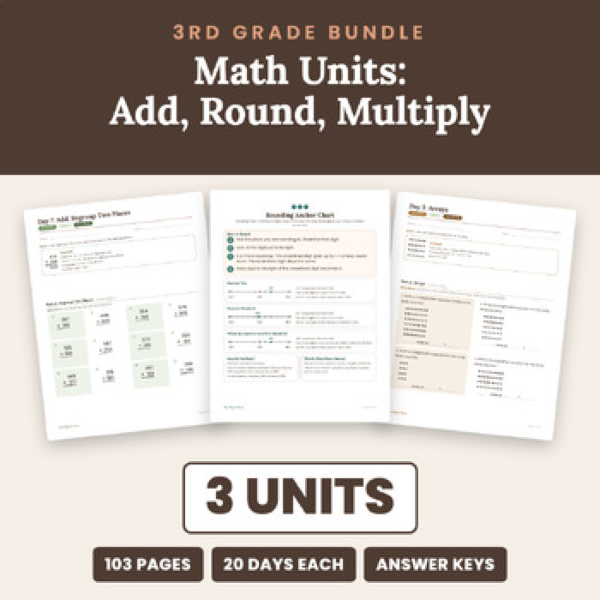
Both use the same page design as the addition and subtraction units: a goal and a worked example every day, a Pre-Check and a Post-Check, and answer keys numbered to every page. The 3rd grade math units bundle carries the addition and subtraction, rounding and multiplication units, 103 pages, for $14.95, against $20.85 bought separately.
Where the units fit in the year
The units are written for the weeks you teach the skill. For keeping it sharp afterwards, the weekly homework keeps a mix of the year's skills in rotation every week, and the 20-day test prep cycles the whole year again in the spring.
Frequently asked questions
How long is each addition and subtraction unit?
Twenty days: four weeks of five days, one skill a day. Each unit also has a Pre-Check before Day 1 and a Post-Check after Day 20, with the same skills and new numbers, so growth shows side by side.
Does each day teach, or only practice?
Both. Every day opens with a goal and a worked example with each step written out, so the example teaches and the page practices. A student who was absent can read the example and start.
Why is the 5th grade unit about decimals?
Fifth grade has no whole-number addition and subtraction standard. Its standard is adding and subtracting decimals to hundredths (5.NBT.B.7), so the 5th grade unit is built on that, plus the place value and rounding standards that support it.
What else is in each unit?
A teacher note, The Unit at a Glance with the standards for each day, a student unit tracker, a toolkit page of three worked examples, answer keys numbered to match every page, and a certificate for the end of the unit.
Does the 4th grade unit cover addition and subtraction with zeros?
Yes. Subtracting across zeros is one of the 4th grade unit's skills, alongside regrouping in several places. The 3rd grade unit covers subtracting across zeros within 1,000.