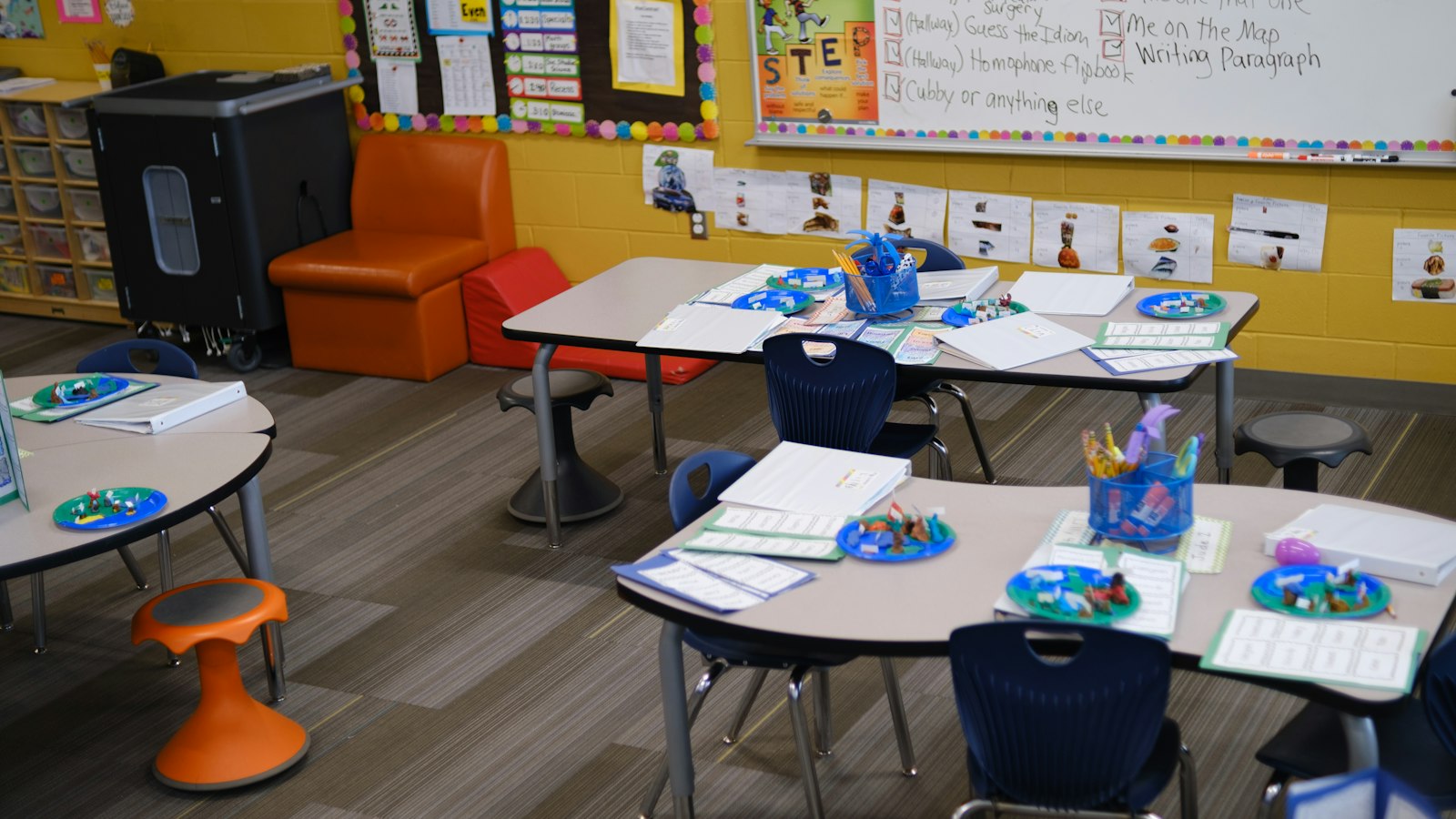
Emergency sub plans for 2nd grade work when three things are true. Every page is review the class has already done. An adult reads each directions line aloud before anyone picks up a pencil. And no page asks a child to work alone for much more than fifteen minutes. Get those right and a room of 2nd graders can carry a thirty to forty-five minute block for a stranger. Get one wrong and the substitute spends the morning walking from desk to desk reading question 4 out loud.
The hard part in 2nd grade is reading. Most of your class can read now, but only just, and a sub day finds the edge of that.
Where a 2nd grader’s independence runs out
By fall, many of your students can decode a page. What they cannot do reliably yet is read instructions they have never seen and act on them. A child reads “Show your work if needed” and still does not know whether that means her. A child reads a word problem with two steps, does the first step, and writes that down as the answer. On a normal day you said the directions at the carpet, so nobody noticed.
A substitute will not know to do that unless the plans tell her. Independence runs out in three places, and each needs something specific in the folder.
Directions. The sub reads the directions line aloud once, then the class starts. Not explained, not modeled, just read. That one habit heads off a lot of raised hands.
Word problems. A 2nd grade word problem is a reading passage with numbers in it. On a sub day, keep them to operations the class owns and sentence patterns they have seen before. A new problem structure is not review.
Stamina. A 2nd grader can stay with one page for a while. Very few can stay with one page for forty minutes. The block needs visible changes of page, each one a fresh start.
Thirty minutes of reading, alone
Design for the child who is barely reading, not the one reading chapter books under the desk. Here is how our 2nd grade reading sub plans lay out the thirty minutes:
- Minutes 0 to 8. The sub reads the passage aloud once while the class follows along. Then students read it again on their own or with a partner.
- Minutes 8 to 16. Six comprehension questions, three choices each, with the passage kept next to them.
- Minutes 16 to 23. A vocabulary and grammar page. The sub reads the directions for each part aloud.
- Minutes 23 to 30. A short writing response on primary writing lines. The sub reads the prompt aloud, then collects all four pages.
The read-aloud comes first because the struggling reader has then heard the text before facing it alone. The questions test whether she understood it, not whether she could sound out every word.
The passages are about 200 words each, in large print, with numbered paragraphs, and they alternate between fiction and nonfiction across the week. The paragraph numbers do real work. “Find the answer in the passage” is too big an instruction for a stuck 2nd grader. “Find paragraph 4 and read it again” is one she can follow. Every comprehension answer in the key names the paragraph that proves it, so when two students disagree, the sub can read that paragraph aloud and let the text settle it.
Forty-five minutes of math, alone
In math the risk is stamina more than reading, so the block uses several short pages instead of one long one. The 2nd grade math sub plans split a 45-minute block across four pages a day:
- Minutes 0 to 5. A warm up page. Directions read aloud once, then go.
- Minutes 5 to 20. Main page A. Anyone who finishes moves straight to B.
- Minutes 20 to 35. Main page B, same routine.
- Minutes 35 to 40. An early finisher page for anyone done. Everyone else keeps working.
- Minutes 40 to 45. Collect, and the sub fills in the What Happened Today page while the class packs up.
On this schedule no page gets more than fifteen minutes, and the class always knows what comes next. The week runs addition and subtraction on Days 1 and 2, money and measurement on Day 3, word problems on Day 4 and mixed review on Day 5. Day 6 is a spare, for when one day out turns into two. All of it is review, so the sub never has to teach anything.
Day 4 is the one to think about ahead of time. A problem like “You have 46 stickers. You get 19 more. Then you give 3 away. How many stickers do you have?” is easy math and a real reading load for some of your class. If you know who those students are, one line in your note (for example, “These students may have word problems read to them:” followed by first names) saves the sub from guessing whether that counts as helping. If a student has read-aloud as an accommodation in an IEP or 504 plan, it is not optional on a sub day. Make sure the sub knows, and share the details the way your school says to.
Every math page ends with a small self-check row, “How did I do?”, with “Got it!”, “Almost” and “Need help” to circle. When you are back, it shows you who felt unsure and on which skill before you have checked a single answer.
What the sub says to a stuck child
The most useful line in a 2nd grade sub plan is what the sub says when a child is stuck, because 2nd graders tend to get stuck out loud and wait rather than move on. Give the sub the exact words.
For math, the plans say: “Have a go at the next one and come back to it.” If the child is still stuck at the end: “Circle it and leave it blank. Your teacher will look at it.”
For reading: “Go back to the passage. The answer is in there. Find the paragraph and read it again.” And if that fails: “Circle the number and move on. Your teacher will look at it.”
The reading plans add one permission: reading a question aloud to a child who asks is fine. Write that into your own plans too. A sub who is not sure whether reading a question aloud counts as helping may say no, and the child who needed it sits through the whole question page. A circled blank is also worth more to you than a guess copied from a neighbor, because it tells you where the gap is.
When the morning goes sideways
If the copier is down or the pages never got run, both packets carry an If You Cannot Print page: twenty minutes of math or twenty-five minutes of reading and language with a whiteboard and nothing else. And so you are not guessing the next day, the What Happened Today pages give the sub a place to record pages finished, who was absent, and who needed help and with what.
What only you can add
Pre-built plans cover the work. They cannot cover your class. For 2nd grade, three lines by first name do most of the job: who reads well enough to be a partner reader, who needs a question read aloud without having to ask in front of everyone, and who has a hard time with changes of page or activity.
Allergies, medication, and who may pick up which child are a different matter. Those belong wherever your school keeps them, not in a worksheet folder. Your note only needs to tell the sub to follow school policy and to check with the office on any health or dismissal question.
The general version of the class list, and the reasoning behind each part of a sub plan, is in what good sub plans actually contain. For the binder around the plans, work through the substitute binder checklist or print the free sub folder checklist. In 4th grade the trouble is different, as the 4th grade version shows: students who know every rule and test the sub on all of them.
If you want the work already done, the 2nd grade math week and the 2nd grade reading week each run five days plus the spare, with answer keys at the back. If you teach a 1st and 2nd grade combination class, or plan with the 1st grade team, the Grades 1 and 2 math bundle holds both grades’ math weeks. The other grades are on the math sub plans page and the reading sub plans page.
Print them once, while you are healthy, and put them in the drawer. The morning you need them, report the absence the way your school requires and tell the office where the folder is.
Frequently asked questions
Where can I get emergency sub plans 2nd grade free?
This store has no free 2nd grade sub plans. The one free sub plans item here, the FREE Emergency Sub Binder Starter Kit, is 3rd to 5th grade math, so it does not fit a 2nd grade room. Two free things do work in 2nd grade: the printable sub folder checklist, and the plan in this post, which you can build from review pages your class already knows: directions read aloud, no page longer than fifteen minutes, and the exact words the sub says to a stuck child.